

Our complete guide to window cleaning in Victoria covers what dirties glass across Greater Victoria generally, and our window cleaning schedule guide covers the general baseline. Salt air deserves its own explanation, because it doesn't behave like rain, pollen, or dust. Salt is hygroscopic. It pulls moisture out of the air and holds it against the glass, which is why a window in Esquimalt, Oak Bay, or James Bay rebuilds its film faster than an inland window collects dust.
We've cleaned windows on homes that face the open Strait directly, and the difference between those properties and an inland home in Saanich or Langford isn't subtle. This is what's actually happening to the glass, what it does beyond the glass, and what changes because of it.
Key Takeaways
- Salt is hygroscopic. It draws and holds moisture against glass, building a film faster than rain, pollen, or dust ever could.
- Left long enough, that film can etch permanently into glass, a distinct mechanism from ordinary mineral spotting.
- Salt exposure doesn't stop at the glass. The ISO 9223 standard classifies marine environments in its most severe corrosion category for metals, aluminum included.
- For the practical schedule and neighbourhood-by-neighbourhood breakdown, see our window cleaning guides. This post is the deeper look at why.
Why Do Windows Near the Coast Get Dirty Faster Than Everywhere Else in Victoria?
Salt is hygroscopic, meaning it pulls moisture out of the surrounding air and holds it against whatever surface it's sitting on. Ordinary dust and pollen don't do this. They sit on the glass until something, rain or a cleaning, moves them along. Salt actively rebuilds its own film by drawing humidity back onto the surface, even between rainfalls.
That's the core difference this post is about. It isn't just that coastal homes get more grime. It's that the grime behaves differently once it's there, and that changes what it does to the glass, the frames, and the hardware around them.
What Is Salt Air Actually Doing to Your Glass?

Salt does two things glass doesn't recover from on its own. First, it forms a hygroscopic film that keeps drawing moisture, so the glass never fully dries the way an inland window does between rains. Second, once the sun bakes that film, it crystallizes into a haze that's more than cosmetic.
A 2019 materials-science study on glass alteration in coastal atmospheres, published in Building and Environment, found that marine salt aerosols increase the hygroscopicity of a glass surface. That opens up the glass structure in a way that favours further alteration. In plain terms: salt doesn't just sit on coastal glass, it changes how the surface behaves. That's why the next round of buildup arrives faster than it would on a window that's only had to deal with rain and pollen.
This is a different mechanism than the mineral, hard-water spotting we cover in our window cleaning schedule guide, which is mostly a sun-exposure issue for south and west-facing glass anywhere in Victoria. Salt etching is specific to direct coastal exposure, and it progresses independently of which direction a window faces.
Which Victoria Neighbourhoods Feel This the Most?
Esquimalt, Oak Bay, and James Bay (part of Victoria) see this the most, because all three have direct, largely unsheltered sightlines to the open Strait of Juan de Fuca. Our complete window cleaning guide already breaks down the specific streets and inlets where we see the fastest buildup, so we won't repeat that list here. What's worth adding is why exposure varies so much between properties that are, on paper, in the same neighbourhood.
Two things decide it: how directly a property faces open water, and how much wind and distance stand between the glass and the shoreline. A home facing the open Strait head-on takes salt spray on a straight line. A home on the same street but facing inland, or shielded by other buildings, gets a fraction of that exposure even a few doors down. Sheltered waterways like the Gorge or Portage Inlet carry brackish rather than open-ocean salt, which is a real factor but a lesser one than a direct strait-facing property.
That's why we don't give a single answer for "coastal Victoria." Distance and sightline to open water matter more than the postal code.
Salt Doesn't Stop at the Glass
Frames and hardware take the same exposure the glass does, just slower. Aluminum frames can develop a white, powdery oxidation, and it's easy to mistake for something a wipe-down will fix. uPVC frames discolour and can turn brittle over longer exposure. Neither is cosmetic once it's set in.
The international ISO 9223 standard for atmospheric corrosivity classifies marine environments in its most severe category for metals, C5. Aluminum is one of the metals it covers. That's not a Victoria-specific finding. It's a recognized engineering classification for coastal exposure generally, and it's the same reason marine hardware anywhere gets specified differently than inland hardware.
- Aluminum frame oxidation: Starts as a faint white powder near hinges and edges, easy to dismiss as dust until it's established.
- uPVC discolouration and brittleness: Develops more slowly than aluminum oxidation but is harder to reverse once the material has changed.
This is exactly why frames are cleaned as a standard part of every visit, exterior and interior, when Two Pines cleans windows. It isn't an upsell. On a coastal property, the frame is doing the same work the glass is, and it needs the same attention.
How Much More Often Should Coastal Homes Clean Their Windows?
We've already set the general schedule in our window cleaning frequency guide: twice a year for most inland Greater Victoria homes, quarterly for direct coastal exposure. The mechanism in this post is why quarterly is the right adjustment, not just a vague "more often." A hygroscopic film that keeps rebuilding itself between rains doesn't wait for a season to pass the way ordinary dust does.
Distance is still the deciding factor, not the neighbourhood name. A home several blocks inland in Esquimalt or Oak Bay, without a direct sightline to open water, may not need the accelerated schedule at all. If you're not sure which category your property falls into, that's exactly what a free quote settles.
What Two Pines Does Differently for Coastal Properties
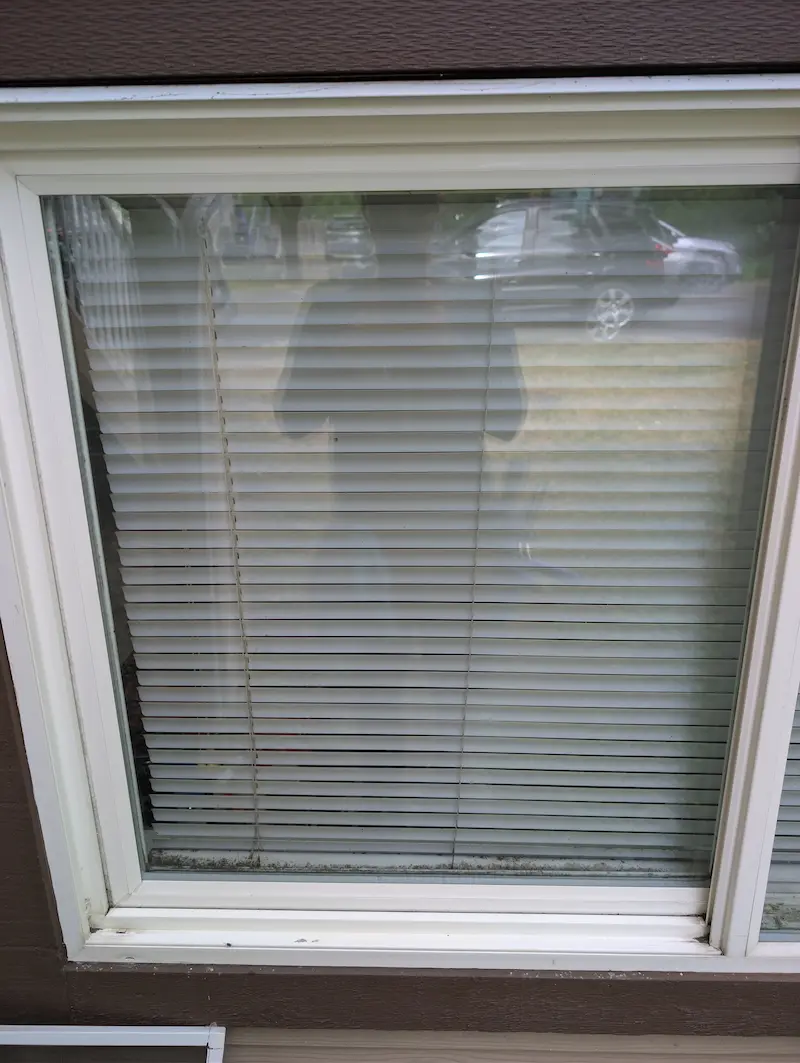
Water-fed pole cleaning with purified water is our default for exterior glass, and that matters more on a coastal property than an inland one. Purified water rinses without leaving mineral residue behind, so we're not adding a second film on top of what the salt is already doing. A traditional squeegee comes out when the situation calls for it.
Frames and tracks are cleaned as standard on both sides, not as an add-on, for the reason covered above: on a coastal property, the frame is under the same load as the glass. If your home faces the Strait directly in Esquimalt, Oak Bay, or James Bay, a free quote will tell you exactly where your property lands on the schedule.
Salt air is a different, faster-acting mechanism than the rain, pollen, and dust that dirties windows across the rest of Greater Victoria, and it hits Esquimalt, Oak Bay, and James Bay hardest. Knowing why changes what actually helps: purified water instead of anything that adds its own residue, and frames treated as part of the job instead of an afterthought.
Frequently Asked Questions
Is salt air really worse for windows than rain or pollen?
Yes. Salt is hygroscopic, so it draws moisture back onto the glass between rainfalls instead of just sitting there like dust or pollen. Left long enough, that film can etch into the glass, which is a different and more permanent mechanism than ordinary surface grime.
How often should Esquimalt, Oak Bay, or James Bay homes clean their windows?
Quarterly for direct coastal exposure, compared to the twice-a-year baseline for inland Greater Victoria homes. See our window cleaning schedule guide for the full breakdown by property type.
Can salt air actually damage window frames, not just the glass?
Yes. Aluminum frames can develop white, powdery oxidation, and uPVC frames can discolour and become brittle with sustained exposure. The ISO 9223 standard classifies marine environments in its most severe corrosion category for metals, which is why coastal frames need the same attention as coastal glass.
Does my home count as coastal if I'm not right on the water?
It depends on your sightline, not your postal code. A property with a direct, unsheltered view of the open Strait takes far more exposure than one a few blocks inland or shielded by other buildings, even in the same neighbourhood. A free quote is the fastest way to know which category your home falls into.
Get a Coastal Property Assessment
Fully insured. 85+ five-star reviews. Free quotes for homes across Esquimalt, Oak Bay, James Bay, and the rest of Greater Victoria.