
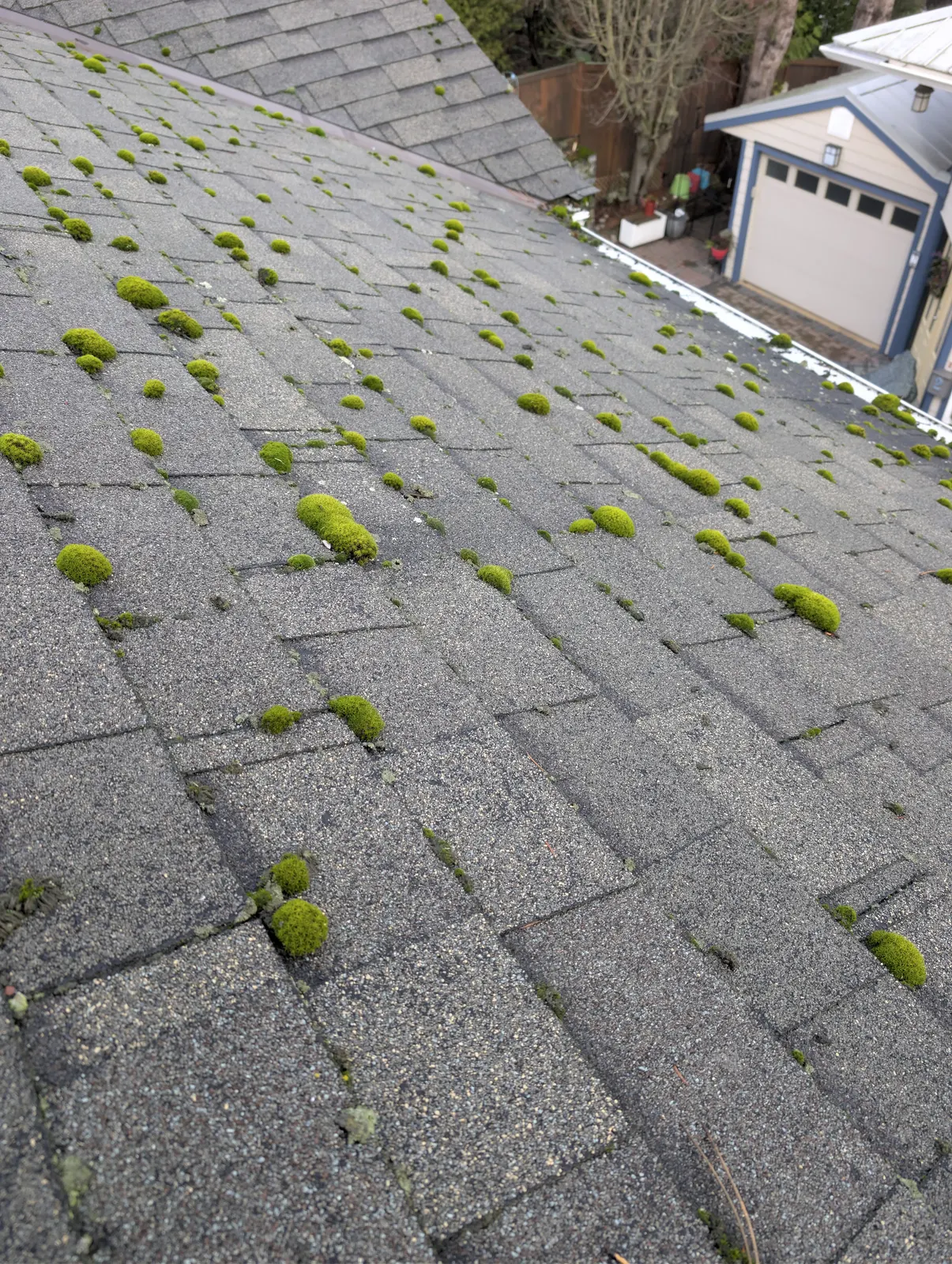
People ask us constantly why we won't just blast a mossy roof with a pressure washer and call it done in twenty minutes. It's a fair question. Pressure washing looks faster, and on a driveway or a patio, it usually is. On a roof, it looks like the deal of the century, right up until the granules start going missing along with the moss. Those don't come back.
For the full picture on roof moss in Victoria, including what causes it and how to spot it early, see our complete guide to roof moss in Victoria, BC. If you're wondering what treatment actually costs, we've broken that down separately. This post focuses on one specific question: soft washing vs. pressure washing for roof moss, and why the method matters as much as the treatment itself.
Key Takeaways
Here's what to know before letting anyone touch your roof:
- ARMA, the trade body representing major shingle manufacturers, states plainly that high-pressure washing "is likely to damage asphalt roofing and should not be used... for any other purpose" (asphaltroofing.org).
- Soft washing, a roof-safe brush plus a low-pressure chemical treatment, is the only method Two Pines uses on a roof. No exceptions.
- Pressure washing isn't the villain everywhere. It's the right tool for driveways, patios, and most hard exterior surfaces, just not a roof.
- Some moss will still be visible right after a soft wash treatment. That's normal: the treatment kills it at the root, and dead patches shed off over the following months as rain washes them away.
- Cedar shake and tile roofs have their own failure modes under pressure. Asphalt isn't the only material at risk.
So, Which Method Should You Use to Remove Roof Moss?
Soft washing, meaning a roof-safe brush followed by a low-pressure chemical treatment, is the right method for moss on an asphalt shingle roof. Pressure washing is not, and no reputable roofing manufacturer recommends it. That's not a style preference. It's a shingle-damage question, and the rest of this post explains why.
One thing worth saying upfront: pressure washing isn't a bad tool across the board. It's just the wrong one for a roof, the same way a chainsaw is a bad tool for cutting a birthday cake. We'll come back to where pressure washing does belong later on.
What's the Actual Difference Between Soft Washing and Pressure Washing for Roof Moss?
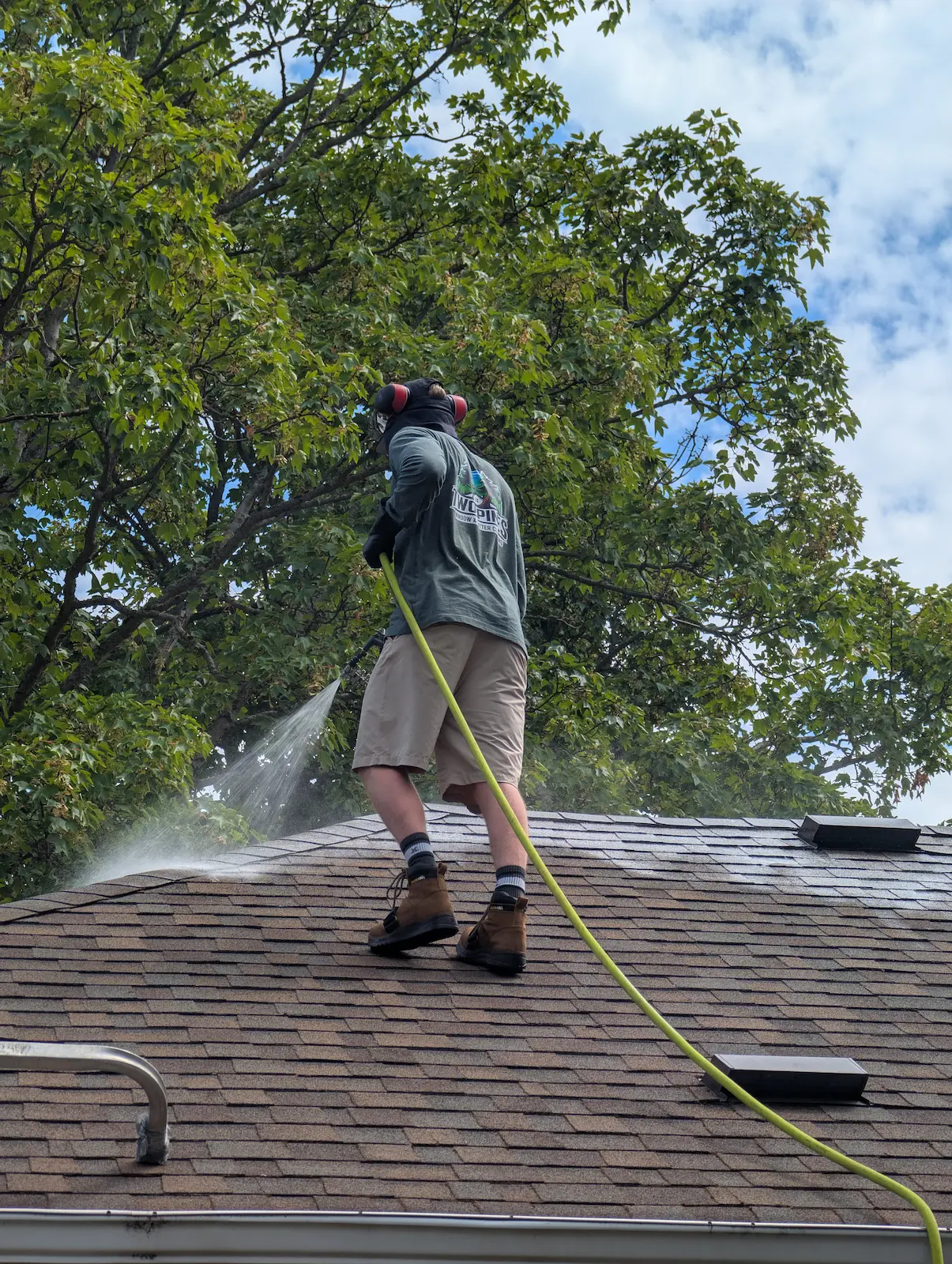
Pressure washing uses water pressure alone, typically between 1500 - 4000 PSI, engineered to physically blast material off a surface. Soft washing uses pressure in the same range as a garden hose, combined with a treatment that kills moss at the root, followed by a gentle rinse. That's the entire difference, and it's why the two methods behave so differently on a shingle.
Pressure washing is mechanical force. Soft washing is a chemical treatment plus a gentle rinse. On our own jobs, that means a roof-safe brush clears the bulk of the moss first, we clean out the gutters afterward since that's where the brushed-off debris lands, then the treatment goes on and is left to work.
Brushing alone doesn't solve it either. Moss regrows from fragments left behind and from spores knocked loose in the process, so a dry brush-only pass can spread it across the roof instead of controlling it (per industry guidance on moss biology). That's exactly why brushing is step one for us, never the whole job: treatment always follows.
| Method | Force Used | On a Roof |
|---|---|---|
| Pressure washer | High, engineered to blast material off a surface | Wrong tool |
| Brushing, no treatment | Manual only, no chemical applied | Spreads spores and fragments |
| Soft wash rig + treatment | Same range as a garden hose, plus a chemical treatment | Recommended |
Why Does Pressure Washing Damage a Roof?
The force that blasts moss off a roof in seconds is the same force that strips the granule layer off asphalt shingles, and once those granules are gone, they don't grow back. What's left is bare shingle, exposed to UV and weather it was never built to face directly.
Granule loss is a durability problem, not just a cosmetic one, and it doesn't show up right away. A freshly blasted roof photographs clean the same day. That's exactly why it's an easy corner for a less careful company to cut: blast it, collect the cheque, and let next year's homeowner discover where the granules went. Efficient, if nothing else. The damage shows up as premature wear months or years later, long after the invoice is paid.
What Roofing Associations Actually Say About Pressure Washing
You don't have to take our word for it. ARMA, the Asphalt Roofing Manufacturers Association, the trade body representing major shingle makers, states plainly: "DO NOT use a power washer... high-pressure washing systems are likely to damage asphalt roofing and should not be used to remove algae or for any other purpose." Closer to home, the Roofing Contractors Association of British Columbia's Consumers Roofing Guide puts it just as directly: roofing product manufacturers and associations recommend against power washing devices, since the force of the water can remove surface material or break pieces away, causing immediate leaks or shortening the service life of the roof system.
Does the Roofing Material Change the Answer?
Asphalt shingles, the large majority of roofs in Victoria, should never be pressure washed. The same logic mostly holds for cedar shake and tile, though the specific failure mode is different for each material.
- Asphalt shingles: granule stripping, covered above. Once the granules are gone, the shingle underneath ages faster.
- Cedar shake: per RCABC's guidance, high-pressure washing "can do more damage than good by removing the pulp of the cedar itself." Pressure can also force water between shakes that were never sealed against that kind of force.
- Tile and metal: less prone to granule loss, but high pressure can still drive water under tiles or strip protective coatings off metal panels.
What we actually work on is asphalt shingle roofs, using the brush-and-treat method described above. We're not going to pretend that scope covers every roof type in Victoria, and we won't overreach into materials outside it. Cedar shake shows up often on older character homes in Fairfield, Oak Bay, and James Bay, and if that's your roof, the pressure-washing risk is even more direct than on asphalt: cedar that's been drying and weathering for decades wasn't built to take that kind of force. Moss or no moss.
Is There Ever a Right Time for Pressure Washing Near a Roof?
Yes, just not on the roof surface itself. Driveways, walkways, and most hard exterior surfaces are legitimate pressure washing jobs. The issue was never the tool. It's using that tool on a surface that can't take the force.
Gutters are a related but separate case worth clearing up here. We flush them with water as part of a gutter cleaning visit, we don't pressure wash them, and it's worth saying plainly since the two get conflated more often than you'd expect.
The pattern to remember is about the surface, not the tool itself. Concrete and pavers can take a beating and come back looking new. A shingle, a shake, or a soft aluminum gutter can't. If a company tells you pressure washing roofs is standard practice for them, that's not an automatic red flag. It's a sign to ask what pressure they use, and what they're doing to protect the surface.
What Does a Proper Soft Wash Roof Treatment Actually Involve?
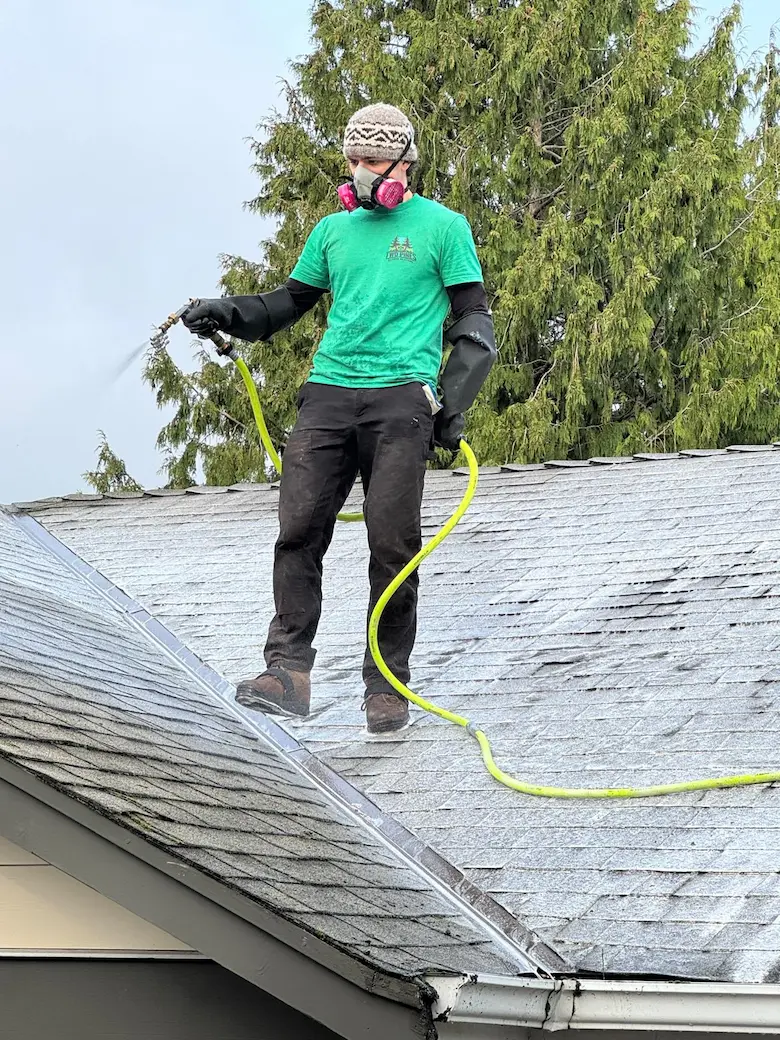
Here's the process in order, since it's the honest answer to what you're actually paying for. A roof-safe brush clears the bulk of the moss first. We clean out the gutters afterward, since that's where the brushed-off debris ends up. Then a chemical treatment goes on and is left to work.
One thing worth setting expectations on: some moss will still be visible right after we leave. That's normal, not a sign the job didn't work. The treatment kills moss at the root, and the dead patches shed off over the following months as rain washes them away. It's the opposite of what a company selling on same-day before-and-after photos wants you to hear. But it's the truth. And it's exactly why a soft-washed roof doesn't look instantly clean the way a pressure-washed one does. If you want the full breakdown of our roof moss removal service, it's on our services page.
How Do You Choose the Right Method for Your Home?
If it's your roof, it's soft washing. If it's a driveway, patio, or most hard exterior surfaces, pressure washing is fine.
A quick self-check: what's the surface, asphalt, cedar, or tile, and is the warranty still active? The material changes how expensive it gets to find out the hard way, not the verdict. And most manufacturers file pressure washing under "improper maintenance," which in plain terms means they won't pay to fix what it caused.
Cost differences between the two methods are usually smaller than people expect. Total price depends more on your roof's size and condition than on which method gets used, and we'll break that down properly in a dedicated post soon.
One more thing worth checking before you hire anyone: ask what happens after the brush and treatment go on. If the answer stops at "we rinse it off," that's usually just describing a rinse, not a treatment doing any actual work over time. The value in a proper soft wash is almost entirely in what's applied and left behind, not the rinse at the end.
If you're not sure what your roof needs, we're happy to take a look and tell you straight. No pressure, literally or otherwise.
Frequently Asked Questions
Does pressure washing void my roof warranty?
Often, yes. Most major shingle manufacturers treat pressure washing as improper maintenance, and warranty claims for a later leak are routinely denied once a roof has been pressure washed, since it's difficult to prove the washing wasn't the cause. Soft washing doesn't carry that risk.
Is soft washing safe for solar panels?
Yes, when it's done properly. The rinse pressure is in the same range as a garden hose, and the treatment is kept off panel surfaces during application. If your roof has solar panels, mention it when booking so we can plan around them specifically.
How long does a soft wash roof treatment last?
It varies by shade, tree coverage, and how much moisture the roof holds onto, so there's no single number that fits every home. We cover this in more detail in our complete guide to roof moss in Victoria.
Can pressure washing ever be used on siding?
Not on most siding, for similar reasons to a roof. Soft washing is our default there too. See our soft washing service page for the full breakdown of what surfaces it covers and why.
How can I tell if a contractor is planning to pressure wash my roof instead of soft washing it?
Ask directly what method and pressure they use, and whether they're applying a treatment or just rinsing. A contractor who can't answer clearly, or who talks about "blasting" the moss off, is describing pressure washing even if they never use the word.
There's no version of this where pressure washing is the safer bet for a roof. Ask any manufacturer, ask any BC roofing association, or ask the shingle itself, assuming it's still got anything left to say once the granules are gone.
That's the whole case.
If your roof has moss and you want an honest look at what it actually needs, get in touch for a free quote or read more about our roof moss removal service below.
Ready to Get Your Roof Looked At?
Fully insured. 85+ five-star reviews. Free quotes for homes across Greater Victoria.