
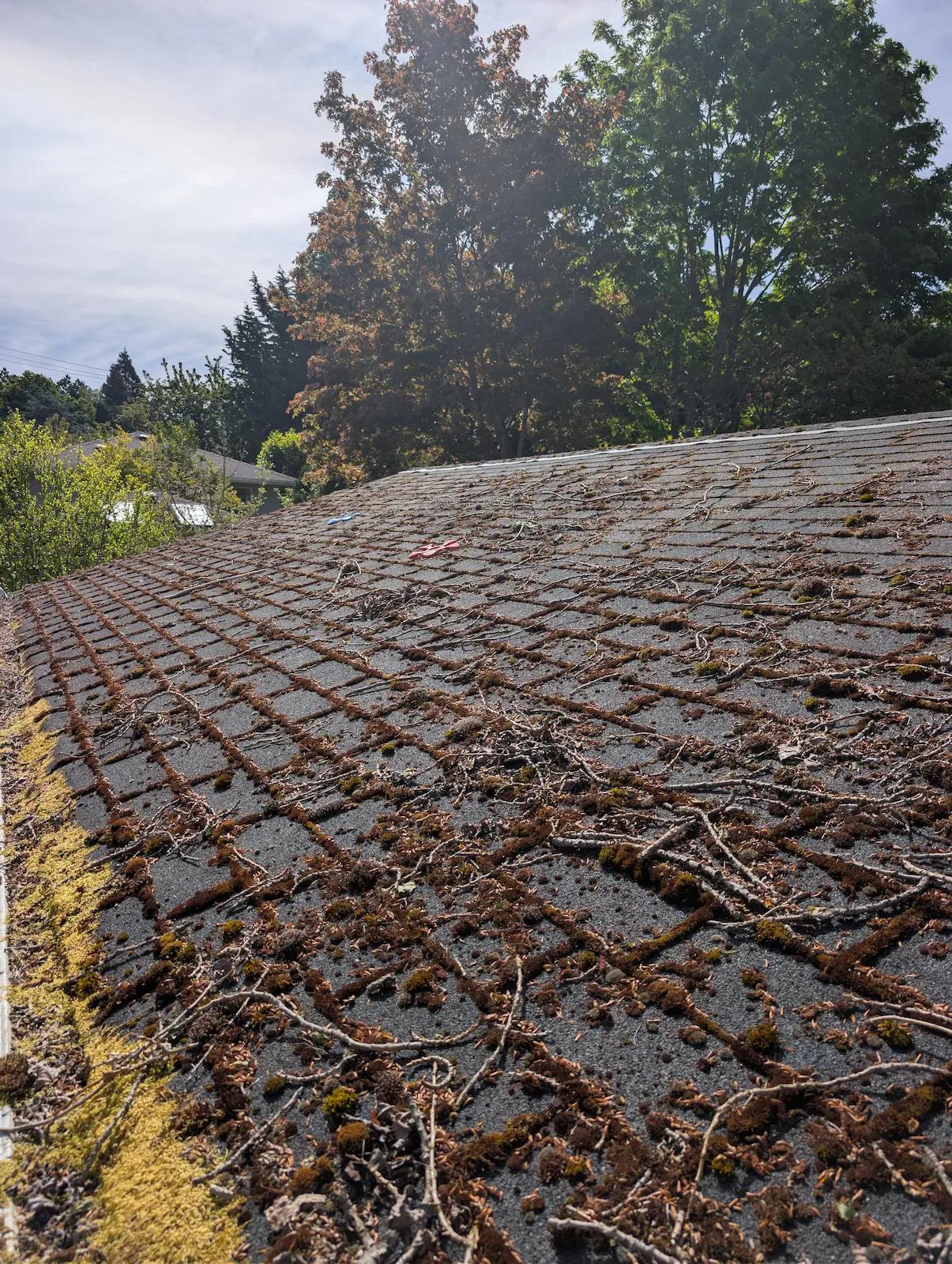
Victoria's roofs grow moss faster than almost anywhere else in Canada. The city sees rain on close to half the days of the year, and the mature tree canopy in older neighbourhoods keeps roofs shaded and damp long after the rain itself has stopped. Put those two things together and you get exactly the conditions moss needs to take hold.
We've treated roofs across Oak Bay, Saanich, and every neighbourhood in between, and the pattern holds everywhere: moss here isn't a cosmetic problem, it's a maintenance item that comes up on a real cycle, the same way gutter cleaning does. Homeowners who've moved here from drier parts of the country are often surprised by how fast it comes back.
This guide covers why Victoria's climate and tree cover make moss such a persistent problem, what it actually does to a roof left untreated, what professional roof moss removal actually involves, when to schedule it, and what it costs. If you're also managing gutters, our complete guide to gutter maintenance for Victoria homeowners covers the rest of the exterior drainage picture, since the two problems are more connected than most guides let on.
Key Takeaways
- Victoria averages 159 days a year with measurable rain, and the mature tree cover in older neighbourhoods keeps roofs shaded and damp for even longer than that number suggests.
- The right method is a roof-safe brush followed by an eco-friendly chemical treatment, never pressure washing, which strips the granules that protect asphalt shingles.
- A treated roof won't look spotless right away. Moss dies at the root and sheds off gradually over the following months, and that's expected, not a sign the job was done wrong.
- Late spring through early fall is the best treatment window, while the roof is dry and the moss brushes off easily.
Why Does Victoria Get So Much Roof Moss?
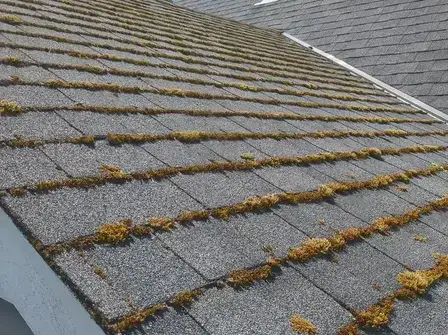
Victoria averages 159 days a year with measurable precipitation and about 675mm of rain overall, according to Environment and Climate Change Canada's 1991–2020 Climate Normals for the Victoria Gonzales station. That kind of persistent, spread-out dampness, rather than a few heavy downpours, is exactly what lets moss take hold and keep growing through most of the year.
Shade compounds the problem. Older neighbourhoods with mature tree canopy, Oak Bay, Fernwood, parts of Saanich, hold onto that moisture even longer, because the trees that make these streets so attractive also block the sun that would otherwise dry a roof out between rains. A roof that gets full sun for a few hours a day sheds moisture fast. A roof shaded most of the day barely dries at all through the wet season.
North-facing slopes and roof valleys are usually where moss shows up first. Both stay shaded longer than the rest of the roof and both collect extra runoff, so they're the first places worth checking if you're trying to catch moss early.
None of this is unique to any one street. We see the same pattern on waterfront properties with ocean-facing exposure and on inland lots tucked under a stand of conifers, wherever shade and dampness overlap for most of the day. The specific trees and layout change from block to block, but the underlying mechanism, sustained moisture plus reduced sun exposure, is consistent across Greater Victoria.
What Does Moss Actually Do to Your Roof?
Moss doesn't just sit on top of shingles. It roots under their edges, lifting them slightly and trapping moisture against the roof deck underneath, which is what drives premature granule loss and, given enough time, fascia and soffit rot along the roofline.
Granules are the protective layer on asphalt shingles. Once moss lifts a shingle edge and moisture sits underneath it, those granules wear away faster than they should, and a shingle with thinning granule coverage ages considerably faster than one that's stayed protected.
We see the knock-on effect in gutters constantly. A roof shedding granules and moss debris sends both straight into the gutter system below, and a gutter full of granule grit and moss fragments drains slower and clogs faster than one collecting ordinary leaf litter. On a lot of the roofs we treat, the moss problem and the gutter problem turn out to be the same job.
Left long enough, the trapped water works its way toward the fascia and roof deck. It's the same mechanism we see from the gutter side: water that isn't draining properly finds the weakest point in the wood and starts breaking it down. Our gutter maintenance guide covers the fascia rot mechanism from the gutter side in more detail, and it's worth reading alongside this one since a moss-covered roof and neglected gutters tend to compound each other.
How Do You Know If Your Roof Needs Moss Treatment?
Visible green or dark patches on north-facing slopes and in valleys are the obvious sign. Streaking below moss clumps, granules collecting in your gutters, and moss creeping toward the ridge line all mean it's time to treat before it spreads further.
The streaking is worth watching specifically. It usually shows up as dark vertical or diagonal lines running down from a moss clump toward the gutter line, a sign that moisture is actively carrying debris and organic material off the moss and down the roof slope. Streaking on its own, without visible moss nearby, often means a patch is growing somewhere higher up that isn't easy to spot from the ground.
A small patch tucked in a shaded valley is easy to ignore. Left alone, it spreads toward the ridge and toward sunnier parts of the roof over a season or two, at which point what would have been a routine treatment becomes a bigger job. We're putting together a full breakdown of every warning sign worth watching for, so check back here for the link once it's published.
Soft Washing vs. Pressure Washing for Roof Moss: What's the Difference?
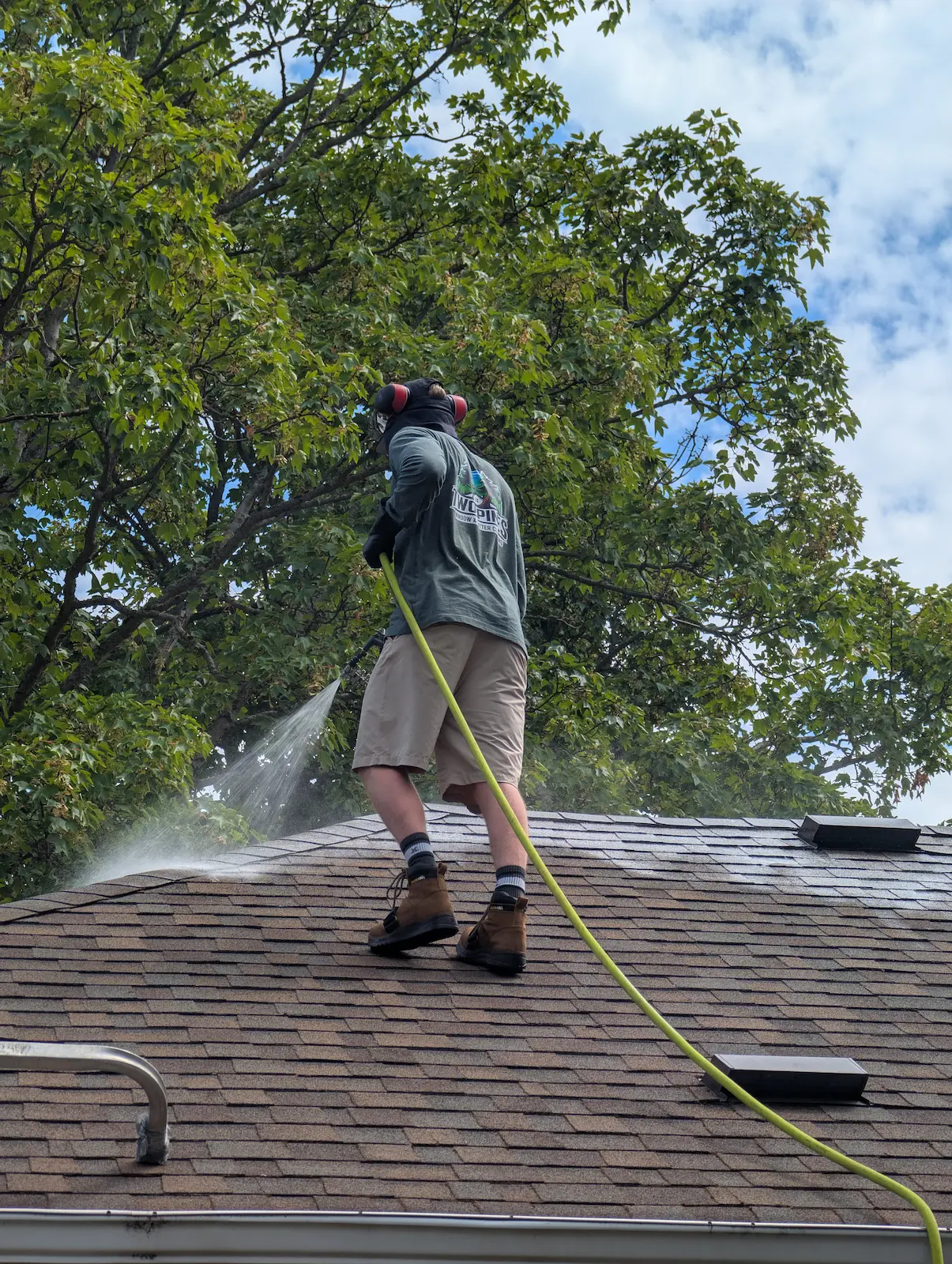
Pressure washing strips granules and shortens the life of asphalt shingles, which is why we never use it on a roof. Soft washing and roof-safe brushing remove the moss without damaging the shingle surface underneath.
High-pressure water is forceful enough to blast moss off in the moment, but it does that by tearing into the granule layer along with the moss. Once those granules are gone, they don't come back, and the shingle underneath is exposed to UV and weather it was never meant to face directly. It looks clean for a season and ages badly for years after.
Pressure washing is faster and cheaper to run, which is exactly why some companies still default to it. It clears a roof in a fraction of the time a proper brush-and-treat job takes, and a freshly blasted roof photographs well for a quote even though the shingle underneath has taken real damage. The trade-off shows up months or years later, not on the day of the service, which makes it an easy corner to cut and a hard one for a homeowner to catch at the time.
| Method | Effect on Granules | How Fast Results Show | Verdict for Asphalt Shingles |
|---|---|---|---|
| Roof-safe brush + eco-friendly treatment | Protects the granule layer, no stripping | Gradual. Dead moss sheds off over the following months. | Recommended |
| Pressure washing | Strips granules, exposes shingle to UV and weather | Immediate. Roof looks clean the same day. | Not recommended |
This trade-off isn't unique to roofs. The same logic applies to siding and other exterior surfaces, which is part of why we use soft washing as our default approach anywhere pressure could do more harm than good. For a full breakdown of the mechanism, the named manufacturer and association guidance behind it, and when pressure washing does make sense elsewhere on your property, see our full comparison of soft washing vs. pressure washing for roof moss.
What Does Professional Roof Moss Treatment Actually Involve?
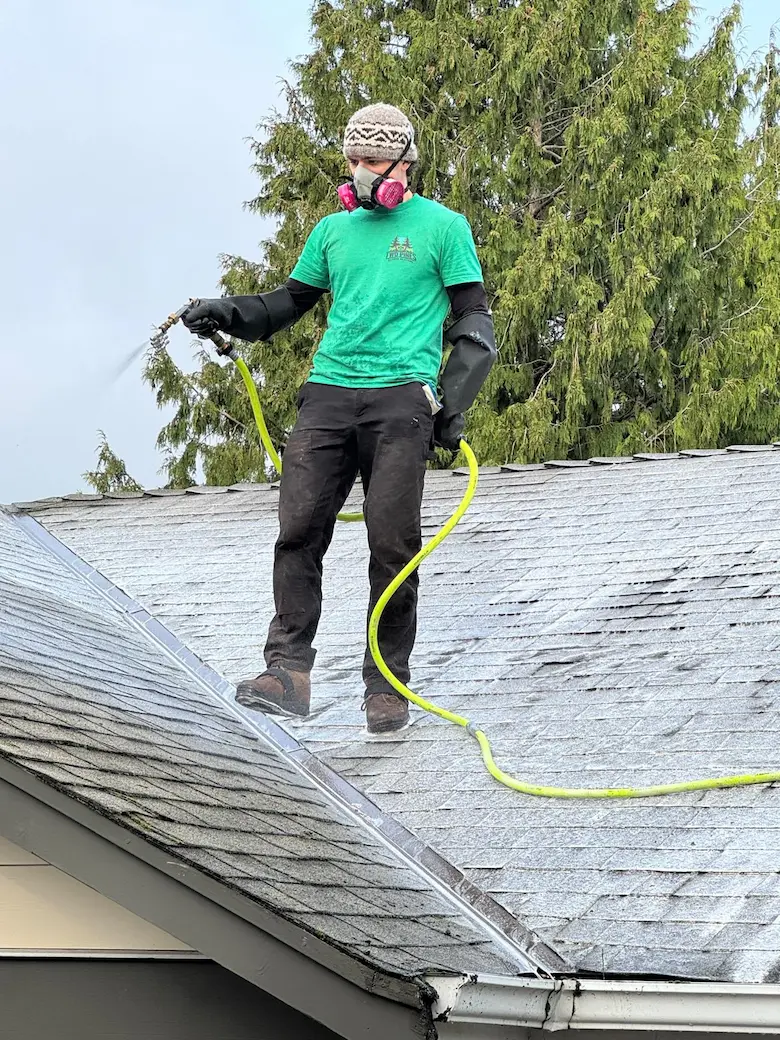
We remove the bulk of the moss with a roof-safe brush designed specifically for asphalt shingles, clear the gutters afterward since brushing knocks debris straight into them, then apply an eco-friendly chemical treatment that's left on the roof to kill the moss at the root over the following weeks.
The brush handles the visible bulk without grinding into the shingle surface the way pressure washing does. Clearing the gutters right after is a small step that's easy to skip, but debris left sitting in a gutter after a roof job defeats a good chunk of the point.
Why the Roof Won't Look Perfectly Clean Right Away
Some moss stays visible immediately after the service. That's normal and expected, not a sign the job wasn't done properly.
The treatment kills moss at the root. The dead patches don't vanish on the spot, they die off and wash away with rain over the following months. A roof that looked mossy on a Tuesday and spotless by the weekend usually means someone scraped or pressure washed it, not that it was treated properly. We'd rather set that expectation clearly upfront than have a homeowner call us worried that nothing happened.
When Is the Best Time to Treat Roof Moss in Victoria?
Late spring through early fall, while the roof is dry, gives the best results in Greater Victoria. Hot, dry weather is best of all: dried-out moss brushes off the shingles more easily, and the treatment gets a dry stretch to work before rain can dilute it.
The treatment needs at least 30 minutes to an hour of dry weather after it goes on, and ideally a full day, so we reschedule when real rain is in the forecast. After a spring or summer treatment, the dead moss dries out over the summer and clears once the fall rains return. We don't recommend treating in winter: the roof rarely stays dry long enough for the treatment to work.
For the month-by-month rain data, what happens to the moss after treatment, and what to do if you've missed the window, see our full breakdown of the best time to treat roof moss in Victoria.
How Much Does Roof Moss Removal Cost in Victoria?
Based on what we actually quote across Greater Victoria, most homes fall in the $600 to $1,200 range for professional roof moss removal, with larger roofs or heavier moss coverage running higher still. Roof size, pitch, access, and moss severity are the biggest factors that move the price up or down.
Generic online cost calculators often show lower numbers, built around a flat rate per square foot that doesn't account for a steep, multi-storey roofline or the heavier moss coverage common on shaded, older Victoria homes. A number that doesn't reflect your actual roof isn't a useful number, which is part of why we quote based on a real look at the property rather than a flat rate.
Commercial and strata roofs price differently again. A strata complex with several connected buildings and multiple roof sections usually gets quoted per building or per phase rather than as a single job, and access considerations, parking, shared walkways, resident notice, add coordination time that a single-family home doesn't need. Commercial flat or low-slope roofs also treat differently than a steep residential asphalt roof, so the pricing logic shifts again.
DIY looks cheaper on paper, but it comes with real fall risk on a wet roof and a real chance of granule damage from improper technique, both of which can cost more than the job would have in the first place. For a full breakdown by roof size, pitch, and moss severity, see our post on roof moss removal cost in Victoria BC.
Is Roof Moss Treatment Safe for Gardens, Pets, and Storm Drains?
We use a biodegradable, eco-friendly treatment specifically because roof runoff drains straight into garden beds, lawns, and in many cases the storm system, so what goes on the roof matters well beyond the shingles themselves.
Roof water doesn't disappear. It runs off into gutters, down through downspouts, and onto whatever's below, landscaping, lawn, sometimes directly into a storm drain that connects to local waterways. A treatment that isn't safe once it's off the roof just moves the problem somewhere else.
Using a biodegradable treatment that's safe for pets and gardens isn't a marketing line for us, it's a practical requirement of doing the work responsibly in a city where nearly every property backs onto a garden, a lawn, or a drainage system that eventually reaches the ocean. It's the same reasoning that keeps us away from pressure washing: the right method is the one that doesn't create a second problem while solving the first.
We get this question most from homeowners with dogs that spend time in the yard right after a service, or with vegetable beds tucked under a downspout. It's a reasonable thing to ask about, and it's exactly why we don't treat it as an afterthought. If a homeowner wants us to time the visit around a pet's outdoor schedule or hold off near a harvest-ready garden bed, that's a normal conversation to have before we start, not an unusual request.
How Can You Keep Moss From Coming Back?
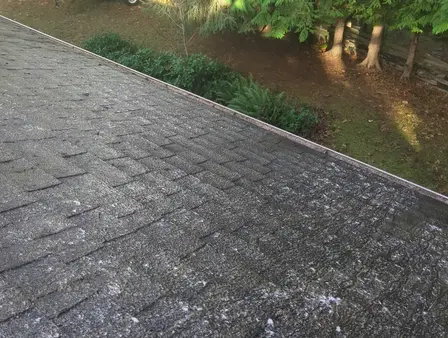
Trimming overhanging branches to let sunlight and air reach the roof, keeping gutters clear so water drains instead of pooling near the roofline, and scheduling a roof check every 12 to 24 months are the three habits that do the most to keep moss from returning.
Sun and air exposure are what dry a roof out between rains, so even a modest trim back of the branches shading a north slope makes a real difference over a wet season. Clogged gutters, meanwhile, hold water right at the roofline exactly where moss establishes first. Our guide to the signs your gutters are failing covers what to watch for, and keeping up with gutter cleaning does double duty for moss prevention as a result.
A quick check from the ground every year or two, looking for new patches on north-facing slopes and in valleys, catches regrowth while it's still a small, affordable job instead of letting it build back up to where it started.
Why Do Victoria Roofs Get Moss Faster Than Almost Anywhere Else in Canada?
Greater Victoria combines a wet-day count well above most of Canada with dense, mature tree cover in its older neighbourhoods, a pairing few other Canadian cities share at the same scale, which is why local roofs need attention on a shorter cycle than national averages suggest.
It's the combination that matters more than either factor alone. A drier prairie city sees far less rain overall, so moss simply doesn't get the sustained dampness it needs to establish, regardless of tree cover. A wetter, heavily treed city further east or on the opposite coast might match or beat Victoria's rainfall, but often without the same mix of mild winter temperatures that let moss keep actively growing through months that would freeze growth solid elsewhere in the country.
Victoria gets the rain, the shade, and the mild winters at the same time, which is the specific combination that keeps roofs damp and growing nearly year-round instead of just through a wet season. We're putting together the full comparison against other Canadian regions, so check back here for the link once it's published.
Frequently Asked Questions
Does roof moss removal damage shingles?
Not when it's done properly. A roof-safe brush removes the bulk of the moss without grinding into the granule layer, and an eco-friendly chemical treatment handles the rest. The damage risk comes from pressure washing, which strips granules and shortens shingle life. We never use it on a roof.
Will moss come back after treatment?
Not if the root cause, shade and trapped moisture, gets addressed too. Trimming back overhanging branches and keeping gutters clear so water isn't sitting near the roofline are the two habits that do the most to prevent regrowth. A check every 12 to 24 months catches new patches early.
Is roof moss treatment safe for plants and pets?
Yes. We use a biodegradable, eco-friendly treatment because roof runoff drains straight into garden beds, lawns, and often the storm system, so what goes on the roof needs to be safe once it's off the roof too.
Why does my roof still have some moss right after treatment?
That's normal and expected. The treatment kills moss at the root, and the dead patches die off and wash away with rain over the following months rather than disappearing the day of the service. A roof that looks spotless immediately usually means it was scraped or pressure washed instead.
Can I remove roof moss myself?
It's possible for light growth on a safe, easily accessible roof, but a wet, mossy roof is genuinely slippery, and improper scraping or a pressure washer can strip granules and shorten the roof's life. For anything beyond a small, low, dry patch, professional treatment is the safer call.
Ready to Book a Roof Moss Treatment?
Fully insured. 85+ five-star reviews. Eco-friendly treatment, safe for gardens and pets. Free quotes for homes across Greater Victoria.