
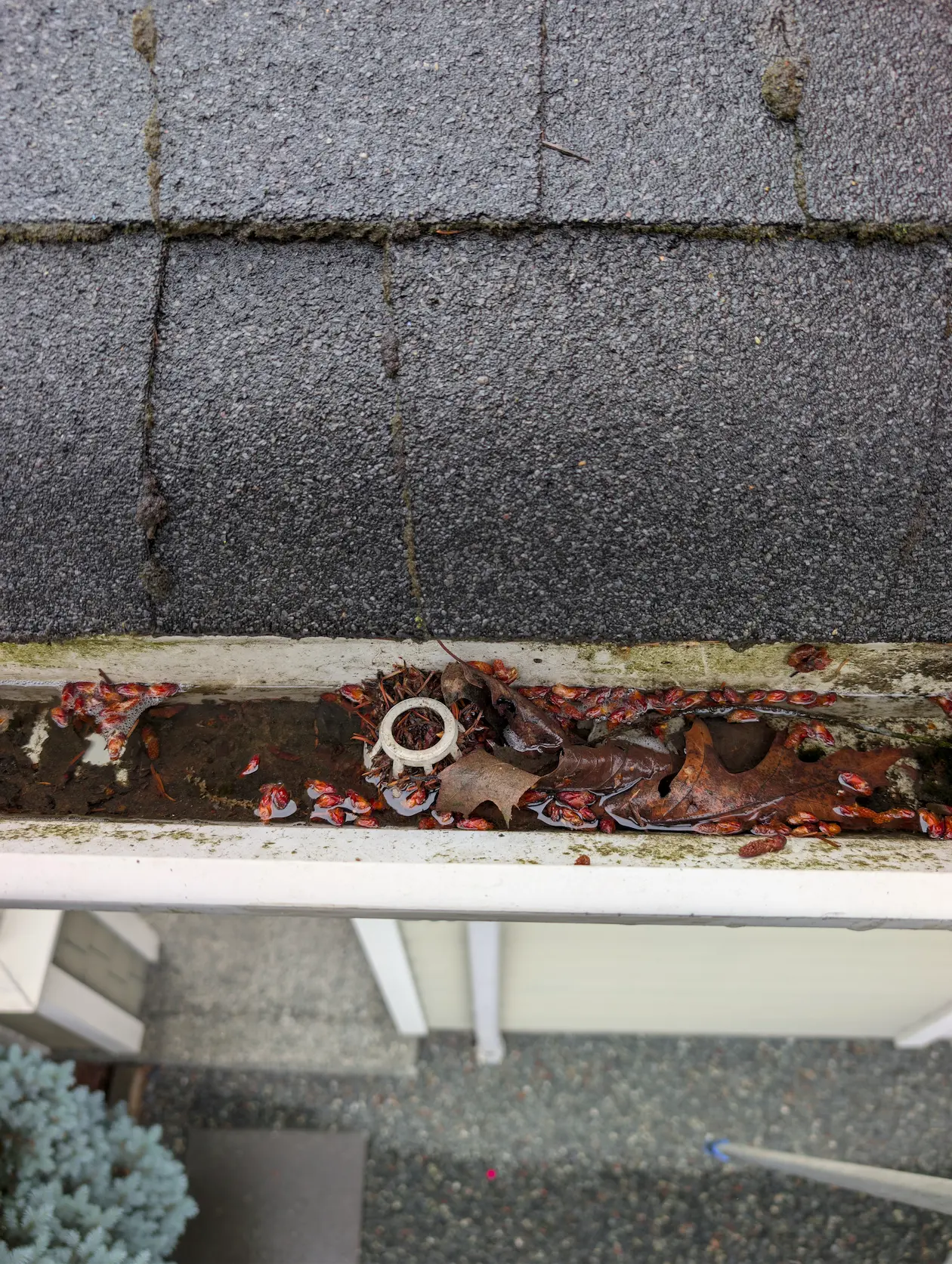
October is the test. The first real storm of Victoria's rainy season arrives and everything that's accumulated in the gutters over summer (cottonwood fluff, arbutus needles, garry oak leaves just beginning to let go) suddenly has nowhere to go. Water backs up and spills.
Most homeowners see that overflow and think: minor drainage problem. A muddy patch below the downspout. A dripping sound during storms. The reality is that what looks like an inconvenience at the gutter is the start of a sequence. Left unaddressed, it works its way through the fascia board, into the wall cavity, and eventually to the foundation. The repair costs at each stage bear no resemblance to the cost of a gutter clean.
Victoria's November averages 129 mm of rainfall, the highest of any month of the year, according to Environment and Climate Change Canada's 1991–2020 Climate Normals for the Victoria Gonzales station. That context matters when you're deciding whether to get gutters cleared before the season turns.
Key Takeaways
- Overflowing water runs behind the gutter first (down the fascia board, not to the ground), which is why the damage is invisible until it's expensive.
- Fascia rot is the first casualty. Once the fascia softens, the gutter separates from the roofline, opening a direct water entry point into the wall assembly.
- Foundation damage from gutter overflow builds over one to three wet seasons through hydrostatic pressure. Repair costs range from $5,000 to $25,000+ USD (approx. $6,800–$34,000+ CAD).
- Victoria's timing trap (fall debris drop in September and October, heavy rains arriving the same month) makes this city harder on gutters than the raw annual rainfall figure suggests.
Where Does the Water Go When a Gutter Overflows?
When a gutter overflows, the water doesn't fall cleanly to the ground. In most overflow scenarios, it runs behind the gutter channel first, back toward the fascia board, behind the lip of the gutter where it meets the roofline. From there it travels down the face of the fascia, finds its way behind the soffit, and begins moving along the top of the exterior wall.
That's the damage pathway most homeowners never see, because none of it is visible from the ground. What is visible (water dripping off the gutter face, or a muddy patch forming below the downspout) is actually the better outcome. The water that runs behind the gutter is the problem.
Victoria makes this worse through a specific timing problem. Cottonwood releases its fluff in May and June, during the dry stretch, when it accumulates without rain to push it through. Garry oak and arbutus begin their main drop in late summer and fall. Cedar sheds year-round. By October, gutters can be carrying the full load of two or three debris seasons, and that's exactly when the heavy rain months begin.
Source: Environment Canada Climate Normals 1991–2020, Victoria Gonzales station
Why Does the Fascia Rot First When Gutters Overflow?
The fascia board is the painted trim that runs along the roofline and holds the gutter brackets in place. In most homes it's Douglas fir or hemlock, untreated softwood that was never intended for sustained contact with water. Overflow running down the back face of the fascia, repeatedly, through a wet season, starts to soften it.
The rot develops slowly and invisibly. By the time it shows from the ground (paint peeling, a gutter that has pulled fractionally away from the roofline), the board has usually lost structural integrity across a meaningful section. By the second wet season of unaddressed overflow, the fascia can no longer hold gutter weight. The gutter separates, and that separation creates a gap at the roofline through which water enters the wall assembly directly.
At that point, it's no longer a gutter problem. Fascia and soffit replacement runs $900 to $6,800 USD (approx. $1,200–$9,200 CAD) per project, according to Angi's 2026 cost data, a wide range that reflects how much of the roofline is affected by the time the problem is caught.
How to Spot Fascia Damage Before It Gets Expensive
- A gutter that has pulled away from the roofline at any point, even fractionally: this is the most reliable early sign
- Paint peeling or bubbling on the fascia face: rot progresses from the back surface inward, so the face discolours before the damage is structurally significant
- A spongy feel when you press the wood: use a screwdriver tip to probe; sound wood resists, rotted wood gives
If you're seeing these signs, the next step is figuring out whether you're dealing with a cleaning problem, a repair, or a full replacement. Our guide to 7 signs your gutters are failing in Victoria gives a clean-repair-replace verdict for each symptom.
What Does Gutter Overflow Do to Your Foundation?
A properly directed downspout deposits water at least 1.5 to 2 metres from the foundation, onto a grade that slopes away from the house. A gutter that's overflowing, or a downspout that discharges directly against the foundation wall, deposits that same water volume right at the base of the house.
Over one storm, that's hundreds of litres. Over a wet season, it's enough to saturate the soil around the foundation perimeter. Saturated soil creates hydrostatic pressure, the force of water-bearing soil pressing against the foundation wall. Foundation materials handle this differently: poured concrete develops hairline cracks over multiple seasons; concrete block has mortar joints that can fail. Either way, the first sign is usually water seeping through the floor-wall joint in the basement, slow and easy to attribute to something else.
Foundation crack repair ranges from $5,000 to over $25,000 USD (approx. $6,800–$34,000+ CAD) depending on severity and method, according to Angi's 2026 cost data.
What Proper Downspout Discharge Looks Like
- Minimum 1.5 metres from the foundation. Many BC municipalities require this in their drainage codes
- Grade sloping away from the house at the discharge point: water should move away from the foundation, not pool
- Downspout extensions cost under $20 and are one of the simplest, highest-return things a homeowner can do
What Other Damage Do Overflowing Gutters Cause?
What we typically find when clearing Victoria gutters before the fall rains is more than loose debris. Shingle granules shed from aging asphalt roofing combine with Douglas fir needles and deciduous leaves to compact into a dense sludge that seals the gutter channel and holds moisture long after storms pass. That sitting wet mass is what drives the secondary problems that follow.
Beyond the structural chain, overflowing gutters create secondary problems that compound quickly. Moisture reaching the wall cavity can trigger mould growth within 24 to 48 hours of sustained saturation. Wall-cavity mould is harder to access, more expensive to remediate, and worse for air quality than surface mould, and it can go undetected for seasons.
Standing water in clogged gutters is productive mosquito habitat: larvae can develop in as few as seven days in warm conditions. Carpenter ants follow moisture into damp wood, and softened fascia is exactly what they're looking for. An infestation compounds the structural damage already underway.
Concentrated overflow at one point on the ground does cumulative damage to whatever's below. Plants directly under a chronic overflow point typically die within a season from root saturation. Soil erodes into an increasingly deep trench. None of these are catastrophic on their own, but all of them are symptoms pointing at the same fixable problem upstream.
Why Are Victoria Homes Harder on Gutters Than Most Cities?
Most gutter overflow guides are written for markets where autumn leaf fall is the main debris event: a few weeks each year, then it stops. Victoria's pattern is different.
As covered in Section 1, cottonwood, cedar, garry oak, and arbutus create a year-round debris load that peaks just as Victoria's wet season begins in October. No other major Canadian city stacks those two events so tightly.
The narrow gap between Victoria's fall debris drop and wet season onset is what makes this city harder on gutters than the raw annual rainfall totals suggest.
For a detailed look at how often Victoria homes actually need to be cleaned, broken down by property type and tree coverage, see our guide to gutter cleaning frequency in Victoria.
What Should You Do Before the October Rains?
The most effective intervention is the most straightforward: a gutter clean in October, after the main debris drop and before the November rains set in.
A proper clean covers debris removal from the gutter channel, a full downspout flush, and a flow test at every downspout to confirm water moves through without restriction. We do a ground cleanup as part of every service. The area below is left cleaner than we found it.
For properties with significant conifer coverage (cedar, Douglas fir, or garry oak within range of the roofline), two cleans per year is the right schedule: once in spring to clear winter debris and cottonwood fluff, once in October before the November rains.
For a full look at seasonal maintenance planning across Greater Victoria, including what to look for between service visits, see our complete guide to gutter maintenance for Victoria homeowners.
Frequently Asked Questions
Can clogged gutters really cause foundation damage?
Yes, through hydrostatic pressure from water depositing against the foundation perimeter during overflow. It develops over one to three wet seasons rather than one storm, which is why it's often attributed to something else by the time it shows up. Basement seepage at the floor-wall joint is the typical first sign.
How do I know if my gutters are overflowing?
Look for a shallow trench or eroded soil directly below the gutter line, water staining on the exterior wall or soffit, a gutter that's pulled away from the roofline at any point, or water appearing in the basement after heavy rain without an obvious source. Any one of these warrants a closer inspection.
Is it common for gutters to overflow in normal rain when they're clogged?
Yes. A fully clogged gutter overflows in moderate rainfall, not just heavy storms. The water volume from the roof doesn't change; the capacity to move it through the system does. Once debris restricts flow, the overflow threshold is much lower than most homeowners expect.
How far should downspouts extend from the house?
At minimum 1.5 metres (5 feet) from the foundation, discharging onto a grade that slopes away from the house. Downspout extensions cost very little and are one of the highest-return gutter maintenance steps a homeowner can take independently.