
Victoria receives approximately 675mm of rain per year, but the timing is everything. According to Environment and Climate Change Canada's 1991–2020 Climate Normals for the Victoria Gonzales station, November alone averages 129mm of rain, and the four months from November through February together deliver a little over half of the city's entire annual precipitation.
For homeowners in Greater Victoria, that creates a specific, high-stakes window where partially blocked gutters become a real liability. Add the Douglas firs and cedars that line most neighbourhoods, the cottonwood fluff that fills gutters in June, and the Garry oak leaf drop every October, and you have a combination that makes Victoria tougher on gutters than almost anywhere else in Canada.
At Two Pines Window & Gutter Cleaning, we've cleaned gutters across Greater Victoria year-round and seen firsthand what Victoria's climate does to them. This gutter maintenance guide covers everything: the local rain calendar, the trees that cause the most problems, what a proper professional clean actually includes, what it costs when gutters fail, and how to decide whether gutter guards make sense for your property.
Key Takeaways
- Victoria averages 129mm of rain in November alone. Gutters must be clear before then or water has nowhere to go.
- Local trees (Douglas fir, cottonwood, Garry oak) create debris in every season of the year, not just autumn.
- Most Victoria homes need at least two cleans per year; heavily treed properties need three or four.
- Neglected gutters can cause $5,000–$43,000+ in repairs; annual cleaning costs around $400.
Why Does Victoria's Climate Create a Short, High-Risk Gutter Window?

Victoria's annual precipitation total of roughly 675mm isn't exceptional by Canadian standards — but what matters far more than the annual total is the concentration. November averages 129mm on its own. December follows at 87mm. January and February together add another ~172mm. That's a little over half of a year's rain falling in four consecutive months, according to data from Environment and Climate Change Canada's 1991–2020 Climate Normals for the Victoria Gonzales station.
By contrast, the four months of June through September combined average less than 80mm total. Victoria homeowners are effectively managing a split climate: a dry summer that allows debris to accumulate undisturbed, followed by a sudden shift to a high-intensity rain season that tests every drainage system at once.
The practical takeaway: gutter maintenance in Victoria isn't about keeping things tidy year-round. It's about ensuring gutters are clear and fully functional by late October. That's the preparation window that actually protects your home.
Which Victoria Trees Fill Your Gutters Year-Round?
Most gutter maintenance guides treat debris as a generic autumn problem. In Victoria, different tree species create specific clogging hazards in every season of the year, which is why homes here typically need more frequent attention than the national two-cleanings-per-year recommendation.
Douglas Fir
The most common conifer in Greater Victoria, and evergreen, meaning it sheds needles year-round, not just in autumn. Fir needles are narrow and compress into a dense, felt-like mat when wet, which is particularly effective at sealing downspout entry points. Homes with large Douglas firs close to the roofline typically need three or four cleanings per year rather than two.
Western Red Cedar
Also evergreen, with small scale-like foliage that accumulates constantly throughout the year. Cedar debris mixed with the moisture inside gutters creates conditions that promote organic growth: moss and algae take hold inside the gutter channel itself, compounding the blockage problem beyond simple debris accumulation.
Black Cottonwood (the one that surprises new residents)
Each year in late May and June, cottonwood trees release white seed fluff that floats through the air for weeks and settles everywhere, including gutters, where it compresses into a thick, felt-like layer. Properties near the Gorge waterway, Thetis Lake, and other riparian corridors see the worst of it. Many first-time Victoria homeowners don't realize they need a spring clean specifically for cottonwood season until they're standing under an overflowing gutter in the first summer rain.
Garry Oak
One of the defining trees of the South Coast, with heavy presence in Oak Bay, Saanich, and Esquimalt. Garry oaks produce significant fall leaf drop plus catkins in spring. The leaves are thick, slow to decompose, and once wet they can sit in gutters through an entire winter season without breaking down, forming a persistent, dense blockage.
Arbutus
Less common than the others but present in rocky areas of Greater Victoria, along the Esquimalt shoreline, and in parts of Oak Bay. Arbutus sheds strips of bark and leathery leaves primarily in summer, contributing to gutter debris during the season when most homeowners aren't thinking about it.
No other major Canadian city has this specific combination: year-round evergreen needle shed, summer bark and leaf drop, a cottonwood fluff event in late spring, a heavy deciduous drop in autumn, and then a concentrated winter rain season to wash all of it straight into downspouts. It's what makes gutter maintenance in Victoria genuinely different.
What Does a Victoria Gutter Maintenance Calendar Look Like?
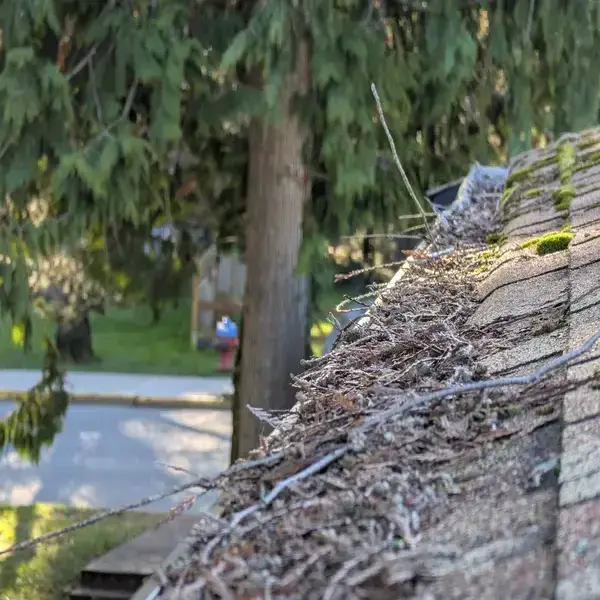
The most effective approach is to think in terms of four seasonal maintenance moments, each tied to what's actually happening in Victoria's climate and tree canopy, rather than the generic "spring and fall" advice written for somewhere else.
In Greater Victoria, evergreen conifers shed year-round, cottonwood season adds a dedicated spring event, and most of the annual rainfall arrives in a short concentrated window. Getting the timing wrong, even by a few weeks, means gutters enter November already carrying a full load.
Late
Feb
Mar
Post-Winter Clean
Winter rains are tapering off, but debris from the fall and winter (compacted fir needles, Garry oak leaves, cedar scale) has likely packed into the gutters. This is also when roof moss is at its most active and visible. Clearing in late February sets you up before cottonwood season begins.
Late
May
Jun
Post-Cottonwood Clean
Once the cottonwood fluff season has finished (typically late May through June), affected properties should clear the accumulated seed material before the dry summer months. Any organic matter left in gutters through a hot, dry summer gets baked in and becomes significantly harder to remove in the fall.
Late
Oct
The Critical Clean Most Important
Late October, after the fall leaf drop has begun but before November's heavy rains peak, is the single most important maintenance window of the year. Gutters entering November blocked or partially blocked will be managing the heaviest rain event of the year without the capacity to do it. This is where most gutter-related water damage in Victoria begins.
Dec
/
Jan
Mid-Winter Check (as needed)
If heavy storms have brought down significant debris or you have dense tree cover, a mid-winter inspection, and flush if needed, can prevent overflow during the January and February rain peaks. Not necessary for every property, but worth considering for heavily treed lots.
How Often Should You Clean Your Gutters in Victoria?
For most homes in Greater Victoria, the baseline is a minimum of two professional cleanings per year: once in late spring and once in late October. Tree cover, roof moss, and property location can all push that number higher, and for some properties quarterly cleaning is the right answer.
| Property Type | Recommended Frequency |
|---|---|
| Few or no overhanging trees | 2× per year (spring + fall) |
| Moderate tree cover or cottonwood exposure | 3× per year (spring, post-cottonwood, fall) |
| Heavy conifers or moss on roof | 4× per year (quarterly) |
| Commercial or strata properties | Quarterly or maintenance contract |
For a detailed breakdown of the specific factors that push a Victoria property to three or four cleanings per year, see our dedicated guide: How Often Should You Clean Your Gutters in Victoria, BC?
What Professional Gutter Maintenance Actually Includes
Professional gutter maintenance does more than clear visible debris. A complete service, the kind that actually protects your home, covers four distinct steps. Understanding what each one does helps explain why skipping professional service or cutting corners on DIY work can leave real damage risk in place.

-
Full debris removal: Everything out of the gutter channel: leaves, needles, compacted organic material, and sediment. Not just the top layer. Compressed debris at the base of the channel is what actually blocks drainage and holds moisture against the gutter seams.
-
Downspout flushing: Every downspout should be flushed from the top with water pressure to confirm it runs clear all the way to the ground-level discharge. Downspout blockages are where overflow damage actually originates. Clearing the visible gutter channel without checking the downspouts leaves the most common failure point unaddressed.
-
Flow verification: Gutters should move water cleanly from roofline to downspout to grade. A proper inspection confirms pitch (no standing water indicating sag), checks that discharge points direct water away from the foundation, and identifies any areas of pooling.
-
Condition report: Visible gutter damage, including loose hangers, separated seams, sagging sections, or early signs of fascia deterioration, should be flagged while the technician has eyes on the roofline. Catching these early costs a fraction of addressing water damage after the fact.
Two Pines includes all four steps as part of every gutter cleaning service across Esquimalt, Victoria, Saanich, Oak Bay, Langford, and throughout Greater Victoria, available 7 days a week.
For a full breakdown of what professional gutter cleaning costs in Victoria, including how storey count, debris type, and access affect the price, see: Gutter Cleaning Cost in Victoria BC: What to Expect.
The Real Cost of Skipping Gutter Maintenance
According to Allstate Canada's 2025 data, water damage claims from external flooding nearly doubled year-over-year (up 94%), and 42% of all property claims submitted between 2019 and 2022 were water damage related. Clogged gutters don't make headlines, but they're a significant contributor to the water intrusion events that generate those claims. Here's what the damage actually costs.
Annual Cleaning
~$400
2 visits per year
Fascia Replacement
$5–12K
Typical home
Foundation Repair
$15–25K
French drain / waterproofing
Basement Flooding
$43K+
Avg. Canadian repair cost (IBC)
Sources: Insurance Bureau of Canada; Allstate Canada (water damage claims, 2025); This Old House (fascia materials cost).
Fascia Board Rot
When gutters overflow consistently, standing water soaks into the wooden fascia boards behind the gutter. Fascia materials run $6–$20 per linear foot according to This Old House; with labour, a full replacement on a typical single-story home with 250 linear feet of fascia could run $5,000–$12,500, a repair triggered entirely by chronic gutter overflow.
Basement Water Intrusion
The Insurance Bureau of Canada reports basement flooding costs an average of $43,000 to repair, and Allstate Canada data shows repair costs have risen nearly 20% between 2019 and 2024. One in ten Canadian homeowners with a basement has experienced flooding, per the same Allstate survey of 1,000 homeowners conducted January 2025. Water pooling at the foundation perimeter from gutter overflow is one of the leading causes, particularly on the established older lots common in Fairfield, James Bay, and Oak Bay where soil drainage may already be limited.
Gutter Separation
Wet, compacted debris is heavy. Over seasons, the weight pulls gutters away from their fascia brackets, causing sagging, separation at the seams, and eventually full gutter failure. Full gutter replacement for a typical home typically runs $1,500–$4,000 or more depending on the system type. For a plain-language breakdown of what each symptom actually means, see our guide to 7 signs your gutters are failing in Victoria, including the clean-repair-replace verdict for each one.
For a detailed look at how gutter overflow triggers each stage of damage, from fascia rot through to foundation water intrusion, see: What Happens When Gutters Overflow, and Why It's Worse in Victoria.
Do Gutter Guards Make Sense for Victoria Homes?
Gutter guards reduce maintenance frequency for many homeowners, but the reality for Victoria properties is more nuanced than the marketing suggests. A 2025 survey of 1,000 homeowners by This Old House found 69% were "very satisfied" with their gutter guards, and 42% reported saving 4–8 hours of annual maintenance time. Average installed cost runs $4,334–$5,168 for a typical home, according to This Old House's cost analysis.
The challenge specific to Victoria: the debris that causes the most damage here (Douglas fir needles, cottonwood seed fluff, and cedar scale foliage) is fine enough to defeat most mid-range gutter guard designs. Needle-slot guards and brush-type guards in particular tend to trap fine debris rather than repel it. Micro-mesh guards are the most effective option for Victoria's debris profile, but they sit at the top of the cost range.
The honest assessment for most Victoria homeowners: gutter guards are a maintenance-reduction product, not a maintenance-elimination product. Even the best guards still require annual inspection and occasional cleaning. For properties with dense Douglas firs directly overhead, they may shift a quarterly cleaning schedule to once or twice per year. For homes with minimal tree cover, the $5,000 installation cost rarely delivers proportional value compared to a consistent professional cleaning schedule.
For a detailed look at guard types, performance in Victoria's climate, and when the investment makes sense, see: Are Gutter Guards Worth It in Victoria? An Honest Answer.
Should You Clean Your Own Gutters or Hire a Professional?
Gutter cleaning is one of those tasks that appears straightforward from the ground and becomes more complicated once you're on the ladder. Here's where the real differences lie.
| Factor | DIY | Professional |
|---|---|---|
| Safety | Ladder risks increase significantly on two-story or sloped lots | Purpose-built equipment; trained for height work |
| Downspouts | Often missed: clearing the channel without flushing downspouts leaves blockages in place | Flushed and verified as part of standard service |
| Damage detection | Easy to miss early signs of fascia rot, loose hangers, or sagging from ground level | Condition reported while eyes are on the roofline |
| Cost | Time + equipment rental or purchase | ~$200–$350 per visit for a standard home in Greater Victoria |
| Best for | Visual inspection from ground; a quick garden hose flush after a storm | Full debris removal, downspout verification, condition reporting |
Signs Your Gutters Need Immediate Attention
Most gutter problems are visible before they become expensive. If you notice any of these signs, don't wait for the next scheduled clean.
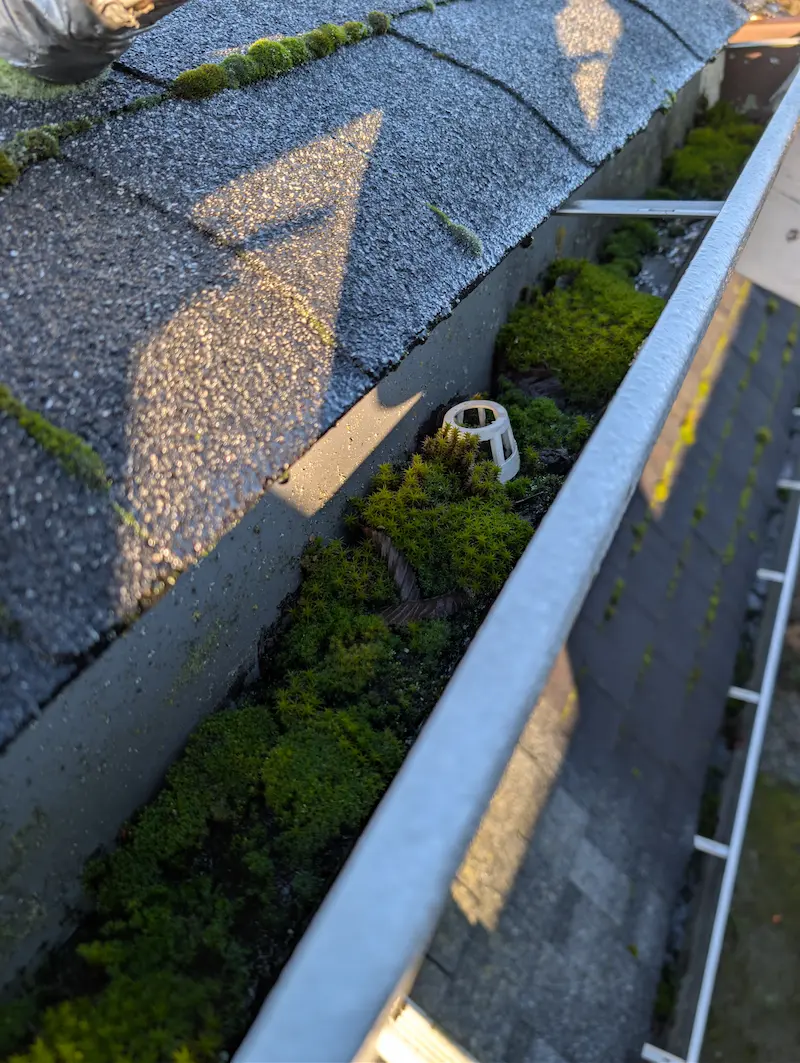
- Water overflowing the front edge during rain: not dripping from the downspout, but sheeting over the front lip of the gutter. This is a blocked downspout or a full gutter.
- Visible debris above the gutter lip: leaves, moss, or plant growth visible from the ground indicate a gutter that hasn't been cleared in a long time.
- Water staining on fascia boards: dark streaks or paint failure directly behind the gutter indicate overflow reaching the wood.
- Gutters visibly sagging or pulling away: gutter sag means the brackets are failing under weight. This needs attention before separation occurs.
- Water pooling at the foundation: water collecting at the base of your home after rain is a sign that downspouts are not directing drainage away from the structure.
Frequently Asked Questions
Late October is the single most important cleaning window, after the main fall leaf drop begins but before November's heavy rains peak. This ensures your gutters are clear heading into the wettest months of the year. A second clean in late May or June, after cottonwood season, completes the baseline maintenance cycle for most homes.
Yes. When gutters overflow, water discharges at the base of the foundation instead of being carried away by downspouts. Over time, this saturates the soil around the foundation, increases hydrostatic pressure, and can cause cracking, heaving, and water intrusion. On sloped lots, common in Saanich and Langford, the risk is higher because water concentrates at the downhill face of the home.
Most homeowners in Greater Victoria pay in the $200–$350 range per visit for a standard single-family home. Homes with multiple stories, steep rooflines, or heavy tree cover typically fall at the higher end of that range. Two Pines offers free, no-obligation quotes, so contact us and we'll give you an accurate price for your property.
For most homes, gutter guards reduce but don't eliminate maintenance. Fine debris common in Victoria (Douglas fir needles, cottonwood fluff, cedar scale) defeats many mid-range guard designs. Micro-mesh guards are more effective but typically cost $4,334–$5,168 installed (This Old House, 2025). A consistent twice-yearly cleaning schedule is more cost-effective for the majority of Greater Victoria properties.
Yes, directly. Moss breaks down over time and washes into gutters with every rain event, contributing a constant flow of organic debris in addition to whatever falls from surrounding trees. If your roof has visible moss growth, your gutters are being loaded continuously. A roof moss treatment paired with gutter cleaning is the most effective way to reduce overall maintenance frequency.
Ready to Book or Just Want an Assessment?
We're based in Esquimalt and serve all of Greater Victoria, available 7 days a week. Fully insured. 85+ five-star Google reviews. Free quotes, no pressure.