
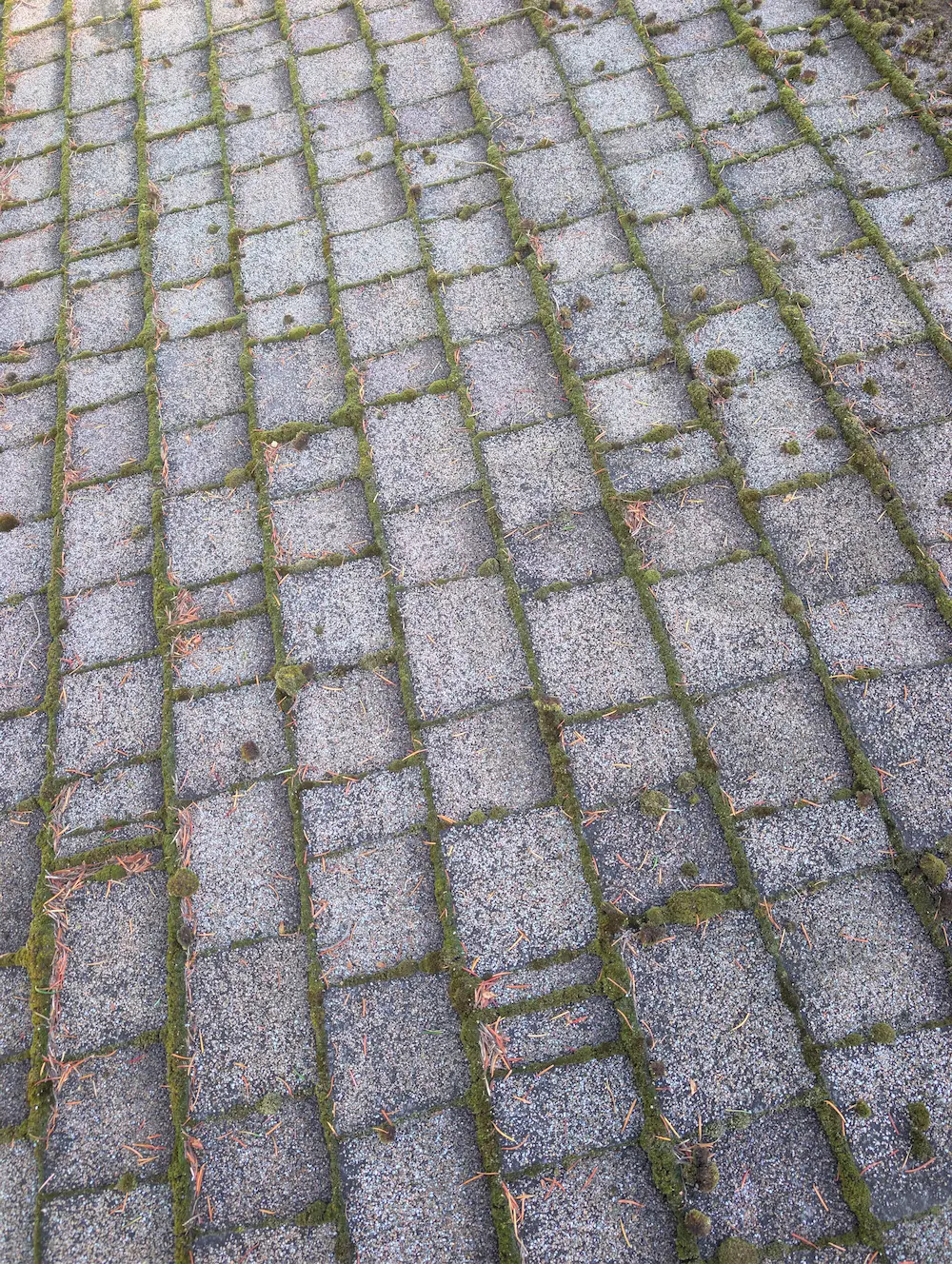
The best time to treat roof moss in Greater Victoria is late spring through early fall, when the roof is dry and the moss comes off easily. If we had to pick one stretch, it's spring into early summer. The roof dries out, the moss lets go without much of a fight, and the dead patches get the whole summer to dry out before the fall rains rinse them away.
If you've already searched this, you've probably found three companies giving three different answers. One says spring, one says July, and one swears by fall. It's enough to make you leave the moss up there out of spite and start calling it a living roof. The answers differ because removing moss and killing moss work best in slightly different conditions, and most companies only talk about the half that suits their method. This post covers both halves, plus what to do if you're reading this in late fall and the good window has already closed.
For the bigger picture on what moss does to a roof and how treatment works, start with our complete guide to roof moss in Victoria, BC.
Key Takeaways
- Late spring through early fall is the best time to treat roof moss in Victoria. Hot, dry weather is best, because dry moss brushes off cleanly.
- Victoria averages 5.4 days with rain in July and 18.9 in November (Environment and Climate Change Canada, 1991–2020 normals).
- The treatment needs at least 30 minutes to an hour of dry weather after it goes on, and ideally a full day.
- After a spring treatment, dead moss dries out over the summer and clears once the fall rains return.
- Missed the window? Book for spring, and get the gutters cleaned before the November rain.
Why Do Moss Companies Give Different Answers on Timing?
Because removing moss and killing it work best in slightly different conditions. Dry moss brushes off the shingles more easily. The treatment, according to Oregon State University Extension Service, works best "when the moss is actively growing, and also during a dry spell when it will not rain more than a 1/2 inch over the next few days."
Those two goals overlap in late spring and early fall, when the moss is still active but the roof stays dry long enough to work. Mid-summer gives you the easiest brushing. Winter gives you neither, because the moss is having the time of its life, and the roof hasn't been properly dry since Remembrance Day.
Our own experience lines up with that. On a hot, dry day, the moss on a Victoria roof comes off with a roof-safe brush and very little effort. On a damp day, the same moss turns into a wet sponge that's in no hurry to leave, and the roof gets slicker under your boots. Given the choice, we'll take the dry day every time.
Some of the disagreement is just scheduling. If a company's calendar is empty in November, November suddenly becomes a great month for moss treatment: "Sure, it's supposed to rain all week, but the moss won't notice. Book now, and we'll talk again in spring when you call asking why it's still green." The moss does notice, and so does the treatment that just ran down your downspouts. Method matters too. A company that pressure washes roofs has different priorities than one that brushes and treats, which is one more reason we never pressure wash a roof.
When Is Moss Actually Growing on a Victoria Roof?
Moss on Victoria roofs grows through the wet months and goes dormant in the dry ones. Researchers writing for the Pacific Northwest Pest Management Handbooks at Oregon State University note that "mosses in the Pacific Northwest flourish in the winter and spring when there is plenty of water, low to moderate light, and moderate temperatures," then go dormant through dry summers until moisture returns.
That's why a roof that looked bright green in March can look brown and crunchy by August. The moss isn't dead, it's just napping, and it's a very light sleeper. The first proper rain in the fall wakes it up, and it picks up right where it left off like nothing happened.
The rain data shows how sharp that turn is. Environment and Climate Change Canada's 1991–2020 climate normals for Victoria International Airport count 5.4 days with measurable precipitation in July and 5.5 in August, then 8.0 in September and 14.1 in October. By November, it's 18.9. Total precipitation nearly triples from September (35.7 mm) to October (96.1 mm).
A treatment needs a dry stretch after it goes on. From May through September, that stretch is easy to find. From November through February, rain falls on more than half the days, and a roof in the shade can stay damp even on the days it doesn't. We call that winter. The moss calls it high season, and it makes the most of every day of it.
Why Is Late Spring Through Summer the Best Time to Treat Roof Moss?
Late spring through summer gives you a dry roof, moss that brushes off cleanly, and a reliable stretch of dry weather after the treatment goes on. In Victoria, May through August averages fewer than 12 rainy days a month, and July and August average fewer than 6, based on Environment and Climate Change Canada's climate normals.
The Rain Rule We Work To
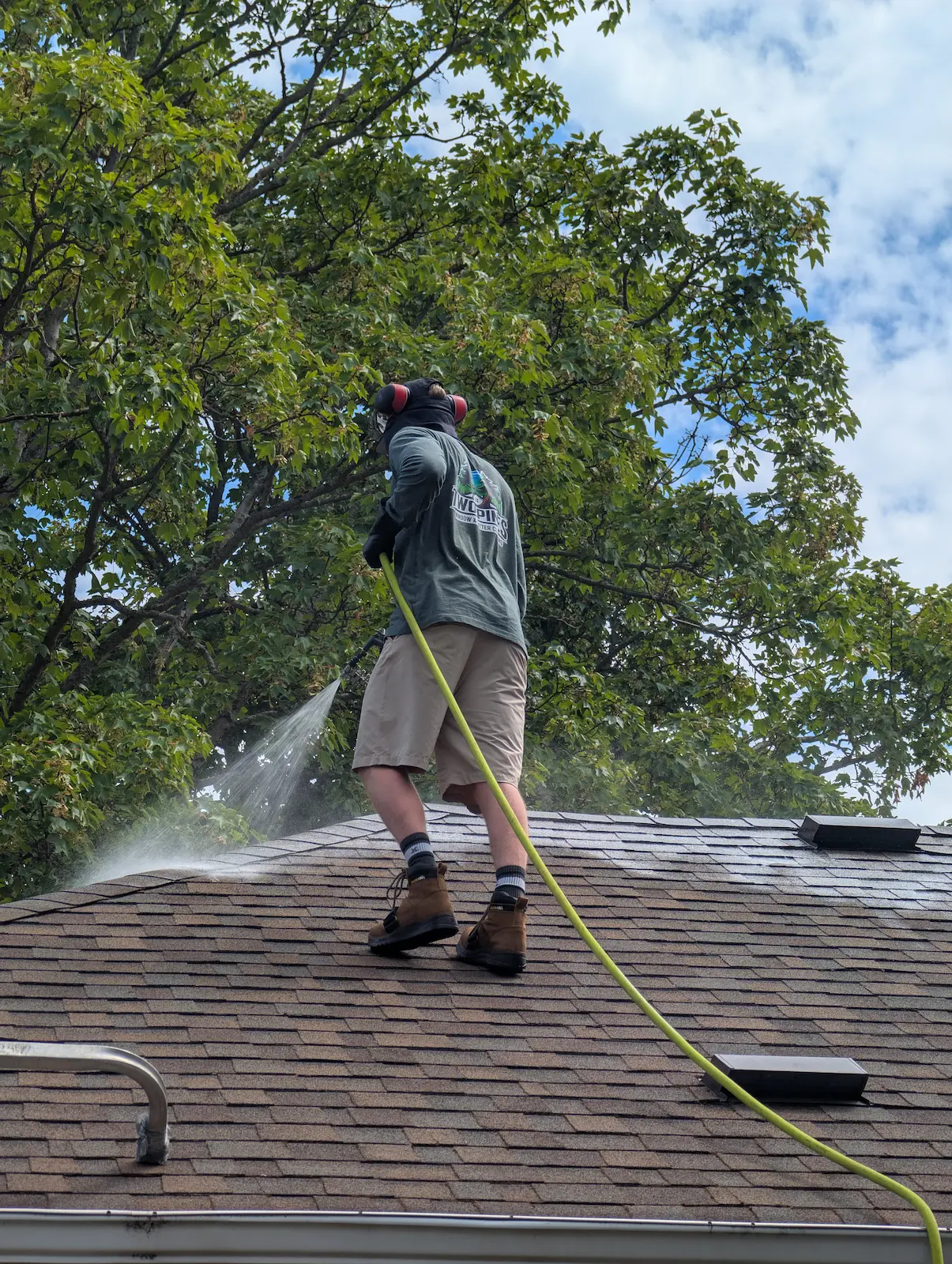
The treatment needs at least 30 minutes to an hour of dry weather after it's applied, and ideally a full 24 hours. Rain any sooner than that dilutes it before it has time to work. We check the forecast before every moss job, and if it calls for real rain, we move the job to the next dry day rather than gamble with it.
Dry weather also keeps the treatment on the roof instead of in the storm drains. OSU Extension makes the same point, recommending dry-weather application to limit runoff into nearby waterways. Our treatment is eco-friendly to begin with, and good timing means it stays on your roof instead of taking a trip down the storm drain toward the ocean.
Why Spring Pairs Well With Your Gutter Cleaning
Every Two Pines moss treatment includes clearing the gutters after brushing, since that's where the loosened moss lands. Book in spring and that takes care of your spring gutter clean too. Homes under heavy fir and cedar cover, which describes a lot of Saanich and Langford, usually still need their fall gutter clean on top of that.
What Happens to the Moss After a Spring Treatment?
A spring roof moss treatment kills the moss at the root. Over the summer, the dead moss dries out on the roof, and it clears once the fall rains come back. The roof won't look perfectly clean the day we leave, and it isn't supposed to. The treatment works over months, not hours.
The Day We're There
Here's what our roof moss removal service looks like on the day. We start by brushing off the bulk of the moss with a roof-safe brush made for asphalt shingles. Next, we clear out the gutters, since that's where everything we just brushed off ends up. Then the eco-friendly treatment goes on and stays on. We don't rinse it off, and neither should you, however tempting the garden hose looks.
Through the Summer
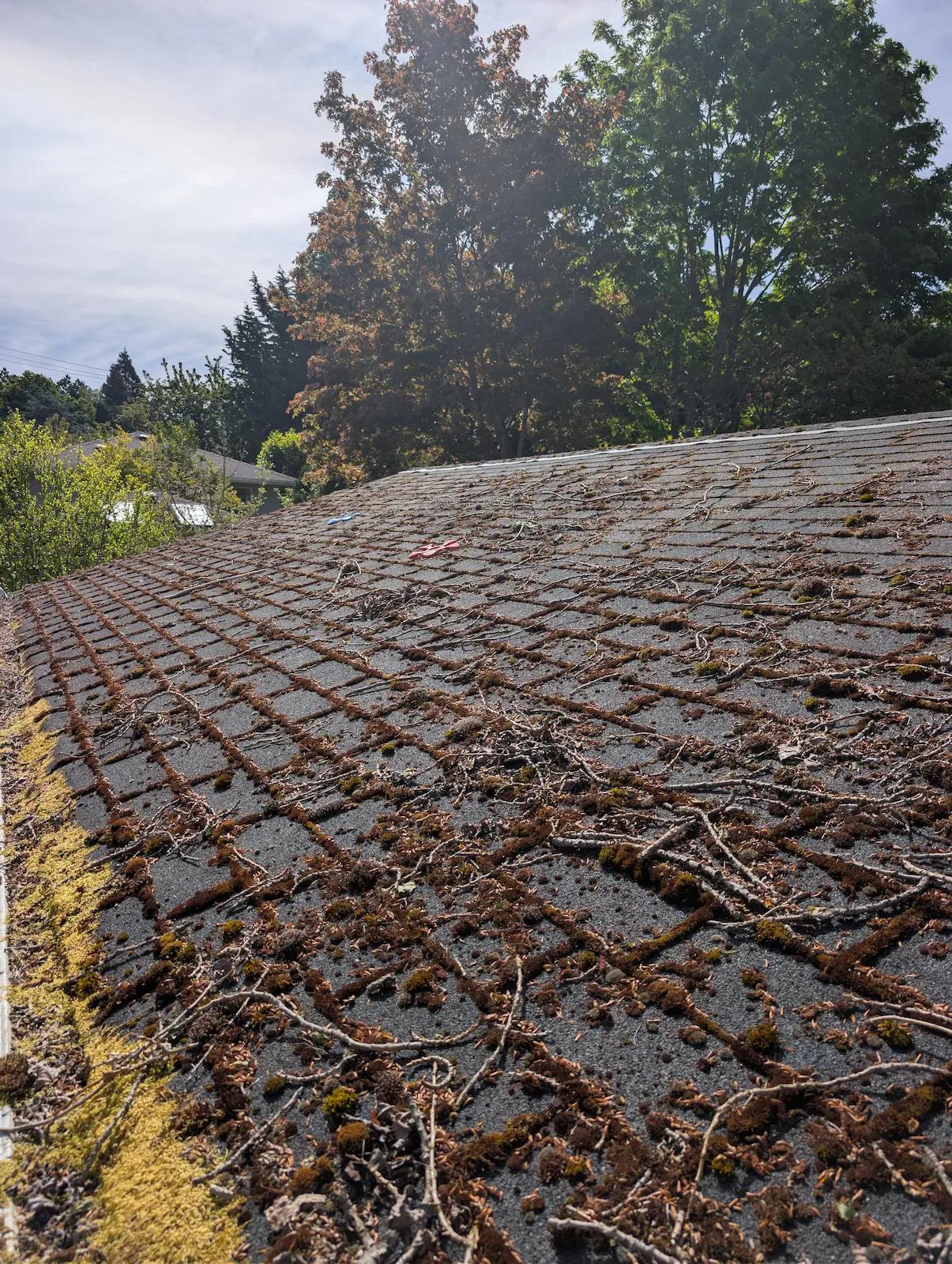
Whatever moss is left turns brown and crispy over the following weeks. Some of it stays visible on the roof. It still looks like moss, and technically it is, the same way a fallen leaf is technically still a leaf. We get asked about it a lot, so our roof moss guide explains why the roof doesn't look perfectly clean right away.
When the Rain Comes Back
By the time September turns into October, the dead moss has spent the whole summer baking on the roof, it's lost whatever grip it had left on the shingles, and the first proper fall storms come through and rinse it off, a little more with every rainfall.
Is Early Fall Too Late to Treat Roof Moss?
Not if the dry weather holds. September averages 8.0 rainy days at Victoria International Airport, and the moss is starting to wake back up, which is when OSU Extension says it takes up treatment best. Early fall is a good time to book.
The catch comes in October. Rainy days nearly double from September to October, from 8.0 to 14.1, and finding a dry day after application gets harder week by week. A treatment in early October can work fine. One in mid-November usually means waiting on a dry forecast that may not come, which has roughly the same odds as a clear run up the Malahat on a long weekend.
Missed the Window? Here's What to Do Before Spring
Book a moss treatment for spring, and get your gutters cleaned before the heavy November rain. We don't recommend treating roof moss in winter. The roof rarely stays dry long enough, and Victoria International Airport averages about 10 nights a month at or below freezing from December through February, which means frost on the shingles on plenty of mornings.
We get it. It's late fall, and roof moss is somewhere around fifth on the list, behind the gutters, the furnace filter, and finding wherever the Halloween decorations went last year. That's fine, because for most roofs the right move this time of year isn't on the roof anyway.
What to Do in the Meantime
- Get the gutters cleaned first. Moss, needles, and debris that wash off the roof all end up there, and overflowing gutters in a Victoria winter are a more urgent problem than a mossy roof.
- Trim back branches shading the roof. More sun means the roof dries faster and moss has a harder time coming back. Hire an arborist for anything you can't reach safely from the ground.
- Stay off the roof. A wet, mossy roof in November is about as slippery as a roof gets, and no amount of moss is worth a fall.
- Book your spring treatment. A free quote now means it's one less thing to remember when the weather turns.
When Should You Never Treat Roof Moss?
Don't treat roof moss in the rain, with rain due within the hour, or on a roof that's wet, dewy, or frosty. Rain washes the treatment off before it works, and a wet roof isn't safe to stand on. Safety guidance from CPWR and NIOSH tells roofing crews to "inspect the roof before work starts, and periodically as conditions change, to see if it is safe to work. Look for icy, wet, or slippery conditions."
We follow the same rule. If the roof is wet in the morning and the forecast won't give it time to dry, we come back another day. That's not us being fussy. Moss treatment is one of the few jobs where the weather after we leave matters as much as the work we do while we're there.
Frequently Asked Questions
Can you treat roof moss in the rain?
No. The treatment needs at least 30 minutes to an hour of dry weather after it goes on, and ideally a full 24 hours. Rain any sooner than that washes it off before it can work. If the forecast calls for real rain, we reschedule to the next dry day.
Why is there still moss on my roof after treatment?
Because dead moss doesn't disappear right away. The treatment kills it at the root, then the leftover moss turns brown and dries out. After a spring or summer treatment, it clears once the fall rains come back and wash it off. A bit of brown moss on the roof the week after treatment is normal.
Can roof moss be treated in winter?
We don't recommend it. Victoria averages around 19 days with rain a month from November through January, and about 10 nights a month at or below freezing from December through February. The roof rarely stays dry long enough for the treatment to work. Book for spring, and get the gutters cleaned before winter.
Should I book moss treatment with my gutter cleaning?
In spring, yes. Every Two Pines moss treatment includes clearing the gutters after brushing, so a spring booking covers your spring gutter clean too. Homes under heavy fir and cedar cover usually still need a separate fall gutter clean.
Timing a moss treatment isn't complicated. Book it when the roof is dry and the moss is ready to come off, let the summer dry out whatever's left, and let the fall rain finish the job.
Ready to Book Your Moss Treatment?
Fully insured. 85+ five-star reviews. Free quotes, 7 days a week across Greater Victoria.