
How bad the moss on your roof is depends on how far along it is, and there are four stages: moss just starting around the vents and skylights, scattered clumps, mats that fill the seams, and a full carpet that hides the shingles. This guide shows what each stage looks like and what it needs, so you can work out where your roof sits and what it'll take to deal with.
The short answer is that every stage should be treated. What changes is how much moss has to come off by hand first, which drives both the wear on your shingles and the price. Caught early, it's a preventative treatment added to a gutter clean, at about half the price of a standard removal. Left until it's a carpet, it's a long job with a brush.
We know how that sounds coming from a company that sells moss treatment. But moss doesn't reach a stage where it packs up and leaves, so the only real decision is how early you deal with it. The one exception is a roof that's too far gone to be worth treating, and we tell people that too.
For how moss treatment works from start to finish, see our complete guide to roof moss in Victoria, BC.
Key Takeaways
- Early moss around vents and skylights can get a preventative treatment with no manual removal, at about half the price of a standard removal.
- Every stage after that needs more brushing, which takes longer and costs more.
- Even gentle brushing disturbs a roof, so catching moss early is both cheaper and easier on the shingles.
- A roof with excessive granule loss, cupping or curling shingles, or a lifespan well behind it is a job for a roofer.
What Changes as Roof Moss Gets Worse?
Manual removal. Thick moss has to be brushed off before the treatment goes on, and the more there is, the longer that takes. That's why a lightly covered roof sits near the low end of what moss removal costs in Victoria, and a heavily covered one can run past the top of it.
It matters for the roof as well as the bill. We use the best brush available, avoid excessive scrubbing, and only touch the areas with moss, not every inch of the roof. Our methods are genuinely gentle, but disturbing a roof isn't good for it, no matter the method. The less there is to remove, the less the roof gets disturbed.
Ask us what's under all that moss and you'll get the same answer: a roof. It's just one that has spent too long holding wet moss.
Stage 1: Just Getting Started
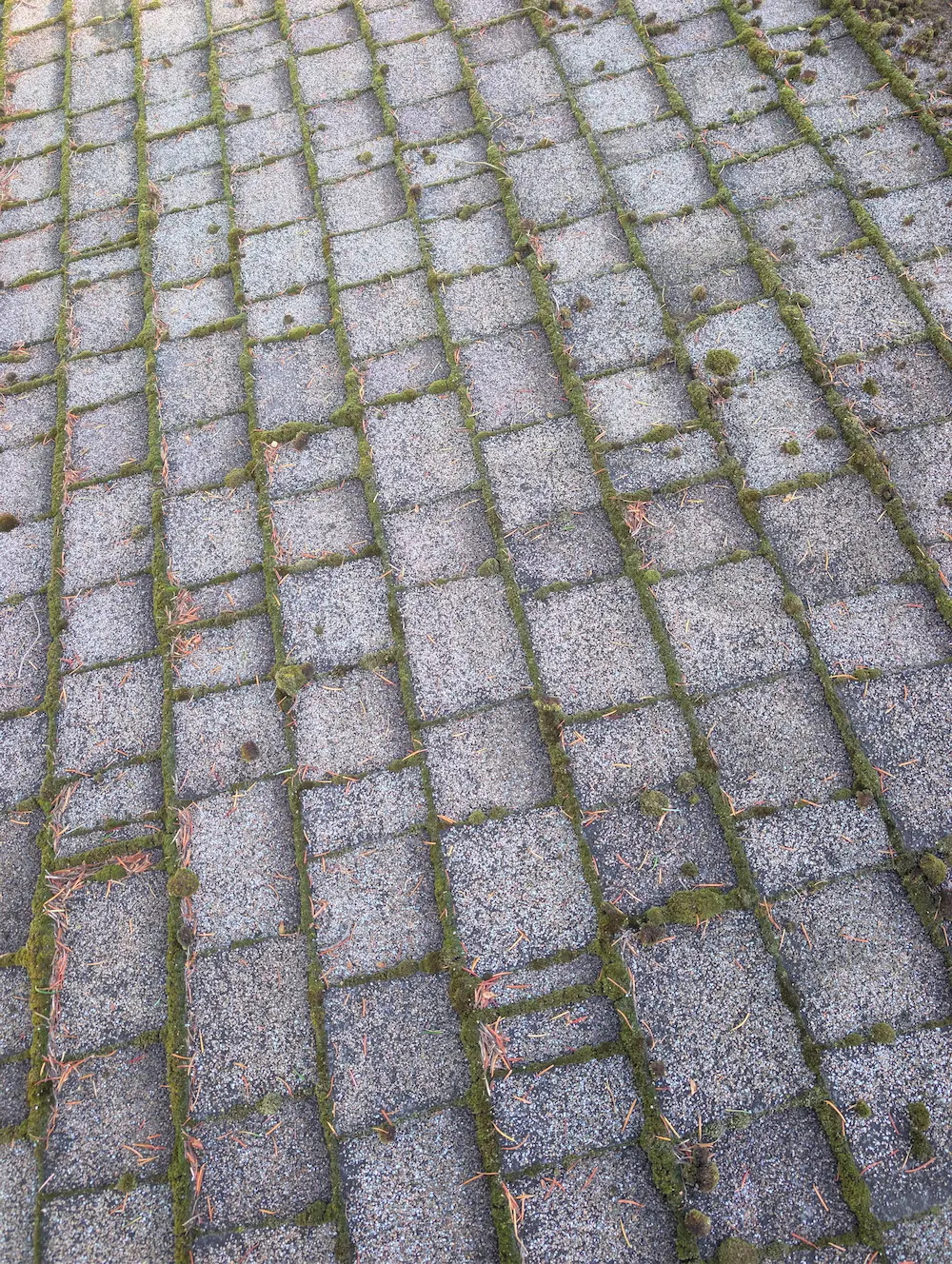
Moss is starting to form around the vents and skylights, and you may see thin green lines along the seams. At this point it has a toehold and a dream.
This is the stage to catch. It doesn't need manual removal, only a preventative treatment, and that's easy to add when you're already having your gutters cleaned. It runs about half the price of a standard removal.
What it needs: a preventative treatment with your next gutter clean.
Stage 2: Clumps
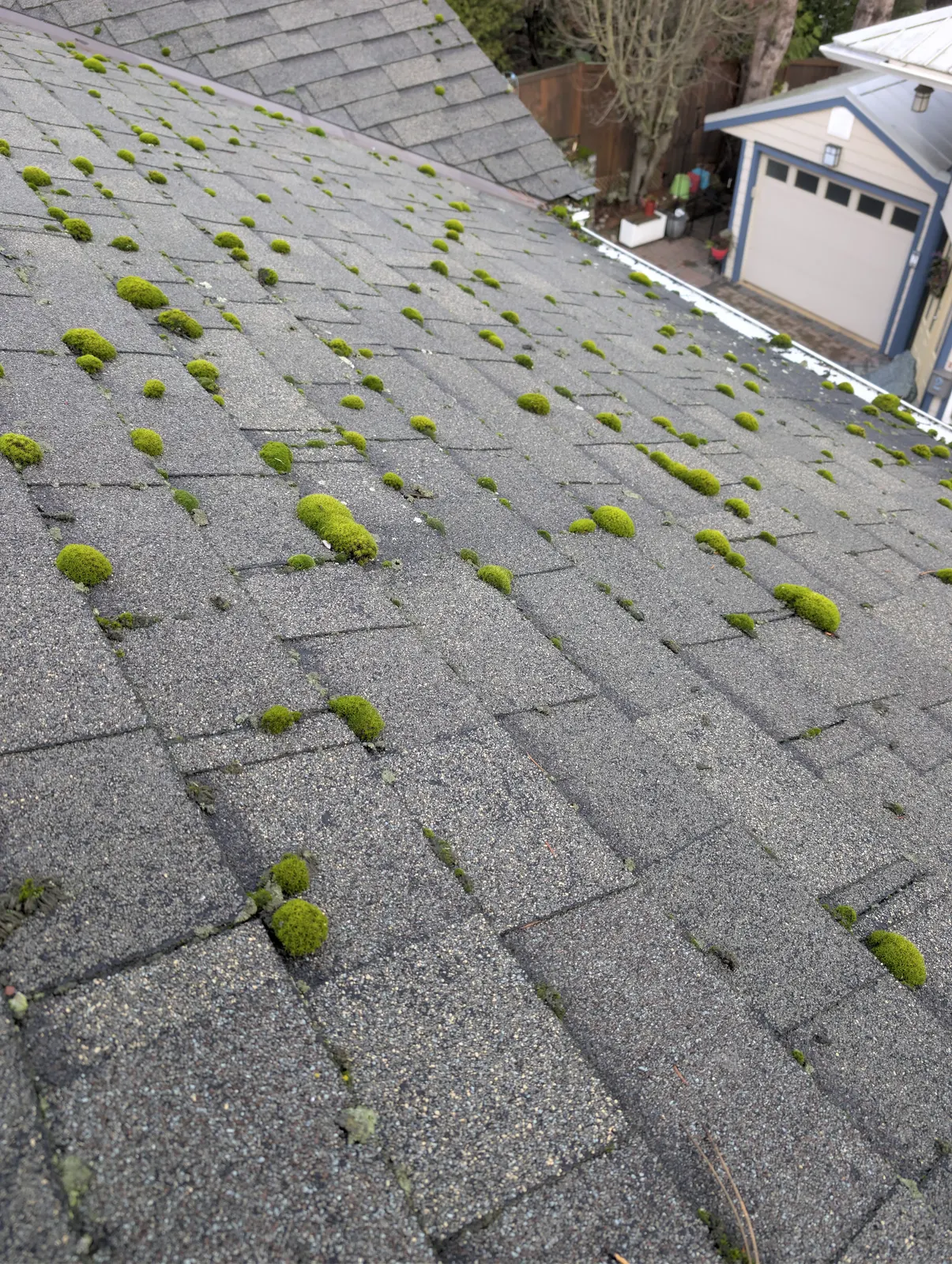
Round green cushions are scattered across the slope. It looks like a very small golf course has started construction. This is where manual removal comes in, because those clumps have to come off before the treatment goes on.
What it needs: brushing and treatment. Book it while the clumps are still separate.
Stage 3: Mats
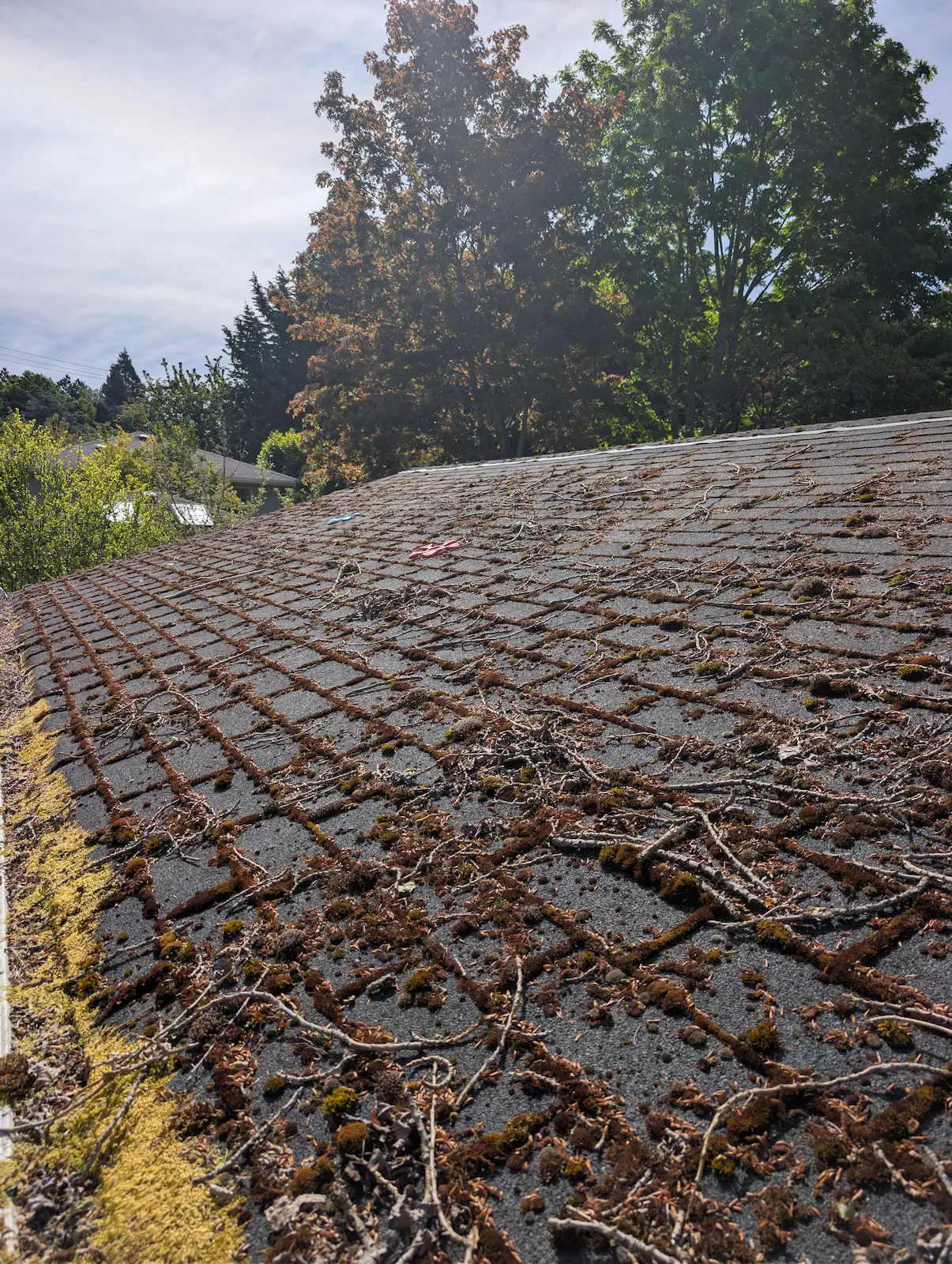
Moss has filled the seams and started catching needles and twigs, so it's now running a compost program with your roof as the bin. According to Oregon State University Extension, moss traps debris and holds moisture, and on asphalt it "can lift shingles and allow water to penetrate and damage underlying layers."
What it needs: brushing and treatment, with more time on the roof and a higher price.
Stage 4: Carpet

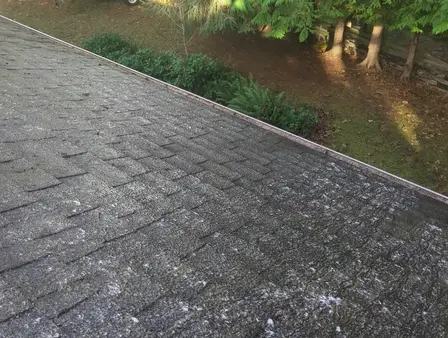
You can't see shingles anymore. It's the only lawn in the neighbourhood you can't mow. This is the most manual removal a roof can need, so expect the top of the price range or past it.
A roof at this stage can still be saved, as long as the shingles underneath are sound. Those two photos are the same roof.
What it needs: the full job, starting with a look at the shingles underneath.
When Is a Roof Too Far Gone to Treat?
Three things tell us a roof isn't worth treating:
- Excessive granule loss. The shingle has already lost its protective layer.
- Age. The roof is well past its warranty or expected lifespan.
- Cupping or curling. The shingles are starting to cup and curl up.
If we see any of these, we'll tell you, and you should talk to a roofer before spending money on moss treatment.
What Looks Like a Stage but Isn't?
Brown moss. It's probably still alive. Untreated moss goes dormant in dry weather and greens back up when the rain returns. It's the guest who went quiet and still has a key.
Black streaks with no moss. That's likely algae, which the Asphalt Roofing Manufacturers Association separates from moss. We treat that too, though on Victoria roofs moss is usually the bigger concern.
What Does Waiting Actually Cost You?
More brushing, a higher price, and a shingle that's been through more. Moss is the most reliable contractor on your street. It shows up every day, and the invoice just comes later.
It can also become someone else's problem to raise. A customer of ours in Esquimalt had their insurance company flag the moss, and we had to clean the roof.
When Should You Book?
Get your quote now and plan the work for late spring through early fall. We don't recommend treating in winter, because the roof rarely stays dry long enough. Cleaning without treatment doesn't change much, and we never pressure wash a roof at any stage. Our roof moss removal service covers homes across Greater Victoria, including the heavy canopy of Oak Bay and Saanich.
The 4 Stages at a Glance
| Stage | What you'll see | What it needs |
|---|---|---|
| 1. Getting started | Moss around vents and skylights, thin seam lines | Preventative treatment with a gutter clean |
| 2. Clumps | Separate green cushions | Brushing and treatment |
| 3. Mats | Filled seams, trapped debris | More brushing, longer job |
| 4. Carpet | No visible shingles | The most manual removal, and a shingle check first |
Frequently Asked Questions
Is a little roof moss okay to leave?
We wouldn't leave it. Small amounts are the cheapest and gentlest to deal with, because a preventative treatment can avoid manual removal altogether, at about half the price of a standard removal.
Is moss treatment worth it on an old roof?
Not always. If the roof is well past its lifespan, has lost a lot of granules, or has shingles cupping and curling, talk to a roofer first.
Do you treat roof algae too?
Yes, though moss is the more common concern on Victoria roofs.
Moss only moves in one direction, and it has no other hobbies. The sooner it's dealt with, the less of it has to come off by hand.
Which Stage Is Your Roof At?
Fully insured. 100+ five-star reviews. Free quotes, 7 days a week across Greater Victoria.