
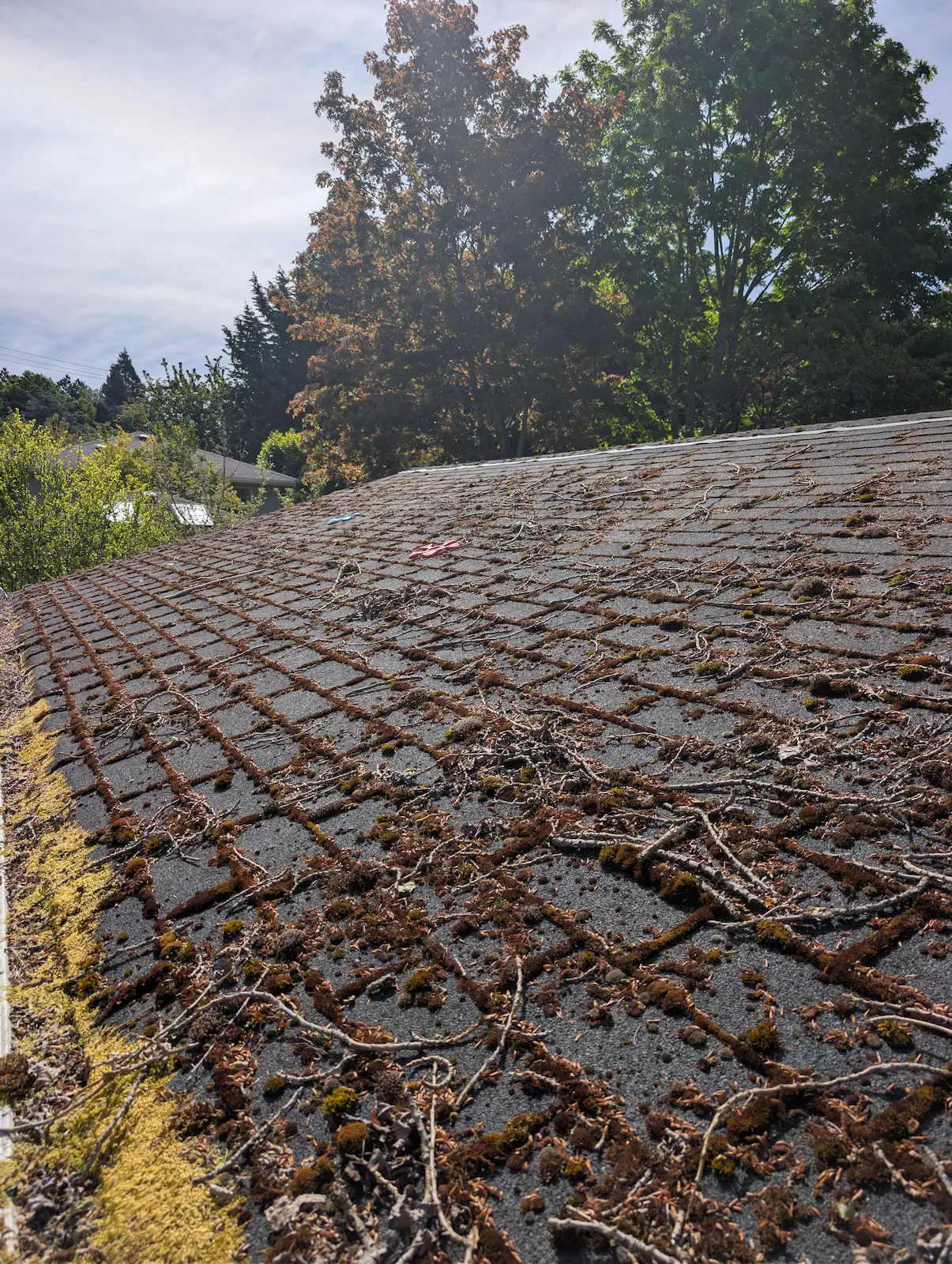
Victoria roofs grow so much moss because two things happen here at the same time: a steady wet season, and winters that almost never freeze. Moss needs both. Plenty of Canadian cities get as much rain as we do. Very few get it on a roof that stays a few degrees above zero all winter long.
We hear the same question on almost every moss job. "It's because it rains so much here, right?" Yes. But that's only half of it, and the other half is why the moss on an Oak Bay roof keeps growing straight through January while moss in Montréal, which gets more wet days than we do, spends a big chunk of the winter frozen solid. We pulled Environment and Climate Change Canada's climate data for eight cities to show you where the difference comes from.
For the bigger picture on what moss does to a roof and how treatment works, start with our complete guide to roof moss in Victoria, BC.
Key Takeaways
- Victoria averages 158 days a year with rain or snow (Environment and Climate Change Canada, 1991–2020 normals). That's plenty for moss.
- Rain alone doesn't explain it. Vancouver, Halifax, Montréal, and St. John's all get more wet days than Victoria.
- The difference is temperature. Victoria averages 1.7 days a year that stay at or below freezing all day. Montréal averages 72.8.
- Wet and mild at the same time means moss keeps growing all winter. Dry summers send it dormant, not dead.
- Shade from mature trees keeps a roof wet the longest. More sun on the roof is the best long-term fix.
Is Rain Enough to Explain Victoria's Roof Moss?
Rain is a big part of it, but not on its own. Victoria International Airport averages 158.1 days a year with measurable rain or snow, according to Environment and Climate Change Canada's 1991–2020 climate normals. That's a steady wet season, and moss needs one. But Montréal, Halifax, Vancouver, and St. John's all get more wet days than we do.
Average Days per Year With Rain or Snow
| City | Wet Days per Year |
|---|---|
| St. John's, NL | 209.6 |
| Vancouver, BC | 169.5 |
| Halifax, NS | 164.8 |
| Montréal, QC | 163.3 |
| Victoria, BC | 158.1 |
| Toronto, ON | 147.3 |
| Regina, SK | 121.9 |
| Calgary, AB | 114.1 |
Days with 0.2 mm or more of precipitation. Source: Environment and Climate Change Canada, Canadian Climate Normals 1991–2020, airport station for each city.
Victoria lands fifth out of eight. St. John's gets 51 more wet days a year than we do. If rain were the whole story, St. John's moss would be the envy of the country. Instead, it spends 63.6 days a year frozen stiff. The west coast of Vancouver Island is wetter again: Tofino averages close to four times Victoria's yearly precipitation, based on Environment and Climate Change Canada's older 1981–2010 normals.
So the rain matters, but it isn't unusual by Canadian standards. What's unusual is what the rain lands on.
So What Actually Makes Victoria Different?
Temperature. Victoria International Airport averages just 1.7 days a year when the temperature stays at or below freezing all day. Toronto averages 49.5, Calgary 61.2, and Montréal 72.8, according to the same 1991–2020 climate normals. Our wet season is also our mild season, and in most of Canada those two things don't overlap.
That overlap is exactly what moss is looking for. Researchers writing for the Pacific Northwest Pest Management Handbooks at Oregon State University note that "mosses in the Pacific Northwest flourish in the winter and spring when there is plenty of water, low to moderate light, and moderate temperatures." Victoria ticks all three boxes, and it ticks the last one all winter long.
Put another way: Montréal moss spends about 73 days a year frozen solid. Victoria moss gets fewer than two days off a year. It doesn't take vacations or call in sick, and through the whole wet season, it never stops growing.
Vancouver, to be fair, is in the same boat. It gets a few more wet days than we do and a similar handful of days below freezing, and its roofs grow moss the same way ours do. That's the BC south coast, not something only Victoria has. Compared against the rest of the country, though, the gap is enormous.
What Does Moss Do on a Victoria Roof All Winter?
It grows. From November through January, Victoria International Airport averages between 18.9 and 19.8 days a month with rain or snow, and almost every one of those days is above freezing by the afternoon. We do get frosty mornings, about 45 a year at the airport, but the roof thaws out on all but a couple of them.
While you're inside, the moss is having its best season of the year. If moss had a business plan, it would read something like this: "Show up in October. Work straight through Christmas. Never take a day off. Pay no rent." It's a strong plan, and on the shady side of a Victoria roof, it works every time.
The trouble is what the moss does with all that water. According to Oregon State University Extension, moss holds debris and moisture against the roof, which encourages fungi and shortens the roof's life. A bare shingle sheds water and dries out between showers. A mossy one stays damp long after the rain stops, all winter long.
Doesn't the Dry Summer Kill the Moss Off?
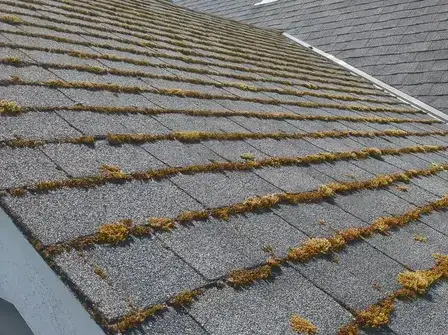
No. Victoria's summers are dry, with 5.4 days of rain in July and 5.5 in August on average, but rooftop moss goes dormant in a dry spell instead of dying, according to the Pacific Northwest Pest Management Handbooks. It turns brown, looks finished, and greens right back up once the October rain returns.
That catches a lot of homeowners out. You look up in August, see brown, crunchy moss on the roof, and figure the problem has solved itself, which it hasn't.
It's playing dead.
Give it one good week of fall rain and it picks up right where it left off, with a little more roof to work with than last year. That dry summer stretch is actually the best time to treat it, for reasons we cover in our post on the best time to treat roof moss in Greater Victoria.
Why Do Some Victoria Neighbourhoods Get Hit Harder?
Shade. The climate sets the stage across all of Greater Victoria, but shade decides which roofs get the worst of it. OSU Extension puts it plainly: moss "depends on shade to thrive." A roof under mature trees dries slowly after every rain, and through a Victoria winter, slowly can mean not at all.

That's why the heaviest moss we see tends to be on older streets with big canopy. Think of the tree-lined blocks in Oak Bay, the Douglas-firs throughout Saanich, and the mature yards around Esquimalt. The big tree that sold you on the house is often the same tree growing moss on it. It's nothing personal, just shade.
Of everywhere we work, though, East Sooke is always the worst. The tree canopy out there is thick, the rain comes in heavier than in the city core, and a roof under that much cover gets very little chance to dry out between storms. Put all three ingredients in one place and the moss doesn't need much encouragement.
Within a single roof, north-facing slopes and valleys usually go first, since they get the least sun. Our roof moss guide covers where to look. The long-term fix is the one OSU plant pathologist Jay Pscheidt gives: "You've got to let the sun in or it will return." Trimming back the branches over the roof does more to keep moss away than any treatment can on its own.
What Does This Mean for Your Roof?
A Victoria roof needs moss attention on a shorter cycle than national advice assumes. Having it checked every 12 to 24 months catches new growth while it's still thin, before it's had a few winters to settle in. Roofs under heavy shade may need it on the shorter end of that range.
When a roof does need treatment, here's what our roof moss removal service involves. We brush off the bulk of the moss with a roof-safe brush made for asphalt shingles, then clean out the gutters, since that's where the loosened moss ends up. Then an eco-friendly treatment goes on and stays on, killing the remaining moss at the root. Whatever's left dies off and washes away with the rain over the following months.
The treatment is biodegradable and safe for gardens, pets, and storm drains, which matters when roof runoff drains straight into the flower beds. We never pressure wash a roof, either. Our post on why we don't pressure wash roofs explains why. To see how far along your own roof is, check the 4 stages of roof moss.
Frequently Asked Questions
Does roof moss keep growing in winter in Victoria?
Yes. Victoria averages around 19 days with rain or snow a month from November through January, and only 1.7 days a year when the temperature stays at or below freezing all day. Wet and mild is exactly what moss grows in, so it keeps growing straight through the winter.
Is roof moss as bad in Vancouver?
Yes, it's very similar. Vancouver averages 169.5 wet days a year and 2.8 days that stay below freezing, close to Victoria's numbers. The whole BC south coast shares the same mild, wet winters that let moss grow year-round.
If the moss on my roof turns brown in summer, is it dead?
Usually not. Untreated rooftop moss goes dormant in dry weather and turns brown, then greens up again once the fall rain returns. Brown moss in August that hasn't been treated is still alive, and it'll be back to work by November.
Will trimming my trees stop roof moss?
It's the best long-term fix, because moss depends on shade and a sunnier roof dries out faster. It won't remove the moss that's already there, though. That still needs brushing and treatment, and trimming afterward helps keep it from coming back.
Lots of places get rain. Victoria gets rain on a roof that never really gets cold, under trees that keep it shaded. The rain sets the table, and the mild winters keep it set all year.
Is Moss Settling In on Your Roof?
Fully insured. 100+ five-star reviews. Free quotes, 7 days a week across Greater Victoria.